
Locations
Catalina Island
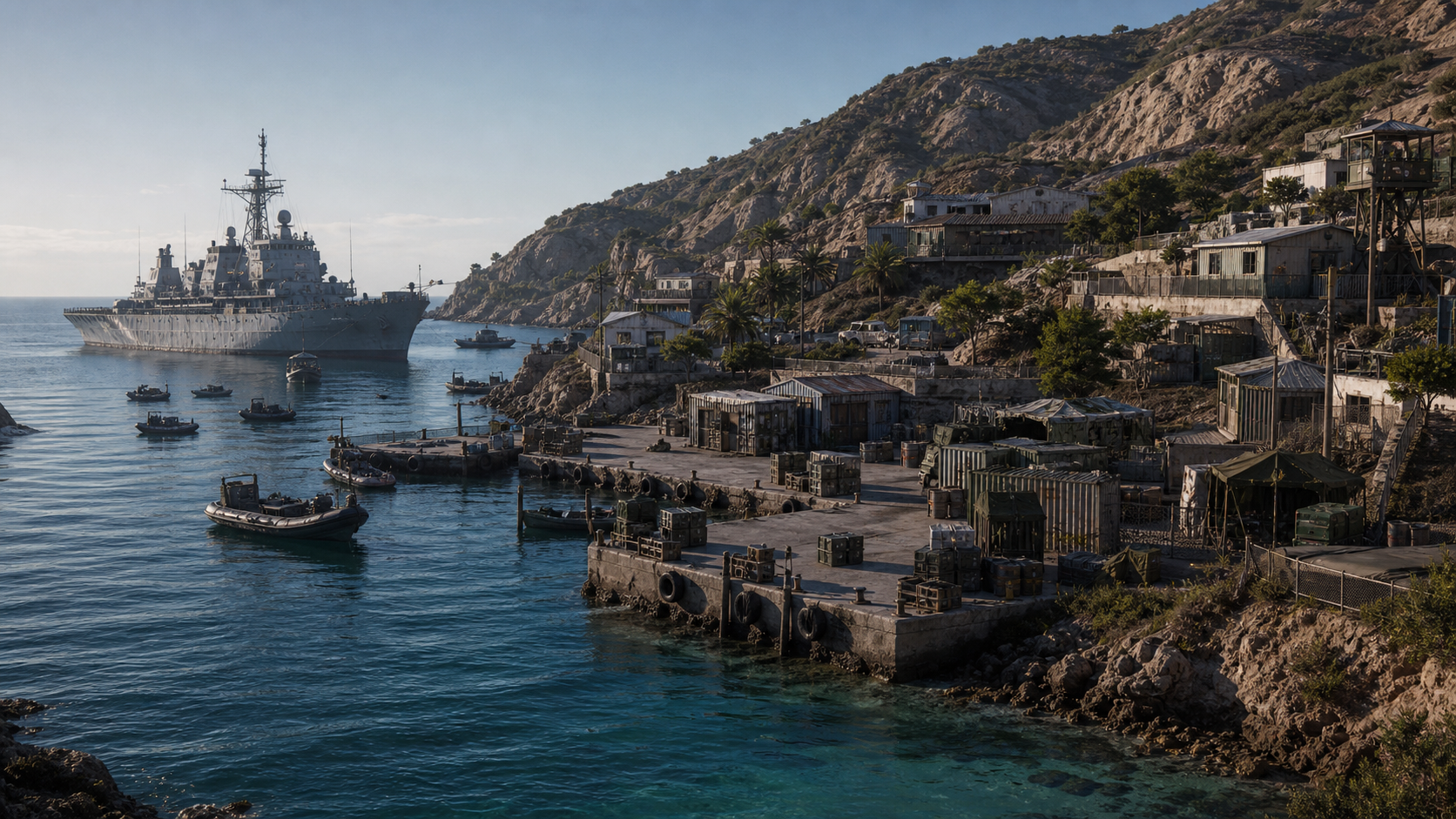
Catalina Island is a major settlement and strategic location in Walt Browning's Extinction Survival branch. Situated off the coast of Southern California, the island becomes a refuge for the surviving crew of the USS Freedom, the small civilian community found at El Rancho Escondido, and later migrants from Lost Valley and other mainland enclaves. Its development changes the branch from the story of one mountain camp into a regional network linked by ships, aircraft, radio, livestock, scientific expertise, and mutual defense.
Quick Facts
- Role
- Locations
- Aliases
- catalina-island, Catalina, Catalina Survivors
Overview
Catalina is not safe merely because it is surrounded by water. John Eric Carver, Rayford "Porky" Shader, Pablo Gonzalez, Antonio Lazzaro, trained volunteers, Boy Scouts, sailors, and military working dog Shrek must first survey the island, clear infected sites, locate its surviving residents, and confront evolved flying Variants that can cross terrain conventional defenses do not cover. The operation also exposes the practical limits of naval survival. The Freedom can produce electricity, launch a drone, and provide weapons, but its engines and generators depend on fuel that no longer arrives through an industrial supply chain.
By the end of Cost of Survival, Catalina has functioning links to Lost Valley, power from the Freedom, livestock, boats, a medical base, an airport fuel point, and a growing population. In Warrior's Fate, the island remains a settlement in its own right and contributes personnel, intelligence, science, naval power, and transport to the wider Southern California campaign. Shader's life there as veterinarian Chloe Maxwell's husband and the reluctant acting sheriff makes Catalina both a military node and a civic community.
Location information
- Field: Type; Detail: Island refuge, naval settlement, agricultural community, and regional support base
- Field: Region; Detail: Santa Catalina Island, off Southern California
- Field: Principal communities; Detail: Avalon, Two Harbors, El Rancho Escondido, airport and ranch sites
- Field: Primary naval asset; Detail: USS Freedom, a littoral combat ship
- Field: Principal mainland partner; Detail: Lost Valley
- Field: Other regional links; Detail: Palomar Mountain survivors, Southern California enclaves, coastal salvage sites
- Field: Key personnel; Detail: John Eric Carver; Rayford Shader; Chloe Maxwell; Pablo Gonzalez; Howard Everly; Erin Donaldson; Captain Dale Thieriot; USS Freedom crew
- Field: Major capabilities; Detail: Harbor access, ship-generated electricity, drone surveillance, aviation support, boats, hospital space, livestock, scientific and technical work
- Field: Major threats; Detail: Dormant Variants, evolved flying Variants, fuel depletion, aircraft maintenance limits, coastal hordes, isolation, supply attrition
- Field: Primary works; Detail: Cost of Survival; Warrior's Fate
- Field: Status; Detail: Functioning allied settlement in the latest documented Survival continuity
Discovery and strategic background
Catalina enters the story after Lost Valley establishes radio contact with the USS Freedom. The ship carries only twenty-three sailors by the time contact is made. Lieutenant Commander Donald Taylor, the chief engineer, speaks for a crew that has survived the destruction of the Pacific Fleet and months of movement along the western coast. Captain Dale Thieriot commands the vessel. Its survival offers a capability Lost Valley cannot reproduce: a mobile naval platform with electrical generation, sensors, weapons, shipboard workspaces, and a drone able to remain overhead for long periods.
The advantage is constrained by fuel. The Freedom cannot operate indefinitely, and a comparatively small delivery barely affects the capacity of a warship. Even using its engines can consume reserves needed to keep generators running. Erin Donaldson's V-22 Osprey can ferry portable fuel bladders, but every flight consumes aviation fuel and adds wear to an aircraft for which replacement parts are scarce. The first debate is therefore not whether the ship is useful. It is whether Lost Valley can support the ship without exhausting the aircraft and people that keep the camp connected to the outside world.
The Freedom reaches Two Harbors and considers Catalina as a permanent home. Ocean distance offers a buffer against the large land-based hordes that destroyed cities and bases. The island also has housing, ports, roads, an airport, farms, fuel stores, and public buildings. Yet its former population numbered in the thousands, and the absence of visible residents does not prove the infected are gone. Carver and Shader remember Operation Liberty, where inadequate surveillance treated apparent emptiness as safety while enormous numbers of Variants remained dormant in structures and underground spaces.
The ship's crew cannot conduct the initial ground reconnaissance alone. Most of its Marines were lost when infected personnel brought the outbreak aboard, and its remaining sailors have limited infantry experience. Carver's group supplies the missing field capability. The partnership begins as an exchange: Lost Valley provides food, trained fighters, pilots, maintainers, and fuel recovery; the Freedom provides maritime reach, electrical power, weapons, aerial surveillance, and a possible evacuation destination.
Planning the island operation
The first aerial circuit detects only scattered clusters, the largest numbering fewer than a dozen. Rather than accept that estimate as definitive, Shader proposes a structure-by-structure clearance resembling urban close-quarters work. Lost Valley does not have enough experienced operators for an island-wide sweep, so Gonzalez expands training to include room entry, breaching, fire discipline, and coordinated movement. Parents are consulted before teenage Scouts join the force. The decision is uncomfortable, especially for Carver because Hope's son Kyle belongs to the generation being trained, but the settlement cannot create adult infantry on demand.
Carver, Shader, Gonzalez, and Lazzaro each lead a team that combines experienced personnel with volunteers and sailors. Over three weeks, the recruits are trained to a basic tactical standard. The Freedom receives roughly twenty thousand gallons of diesel during the buildup, giving it enough reserve to move along the island and support the clearance without immediately sacrificing generator time.
The operation also depends on improvisation. A rigid-hull inflatable boat is carried beneath a Seahawk and used for movement between ship and shore. Existing trucks are reinforced with steel and piping rather than attempting to transport armored vehicles across the channel. Donaldson's Osprey moves fuel and equipment to the airport. Infrared observation, ship fire support, radios, night vision, suppressed weapons, breaching charges, and Shrek's scent work give the small force advantages that raw numbers cannot.
The planning is shaped by a double warning. A quiet island may contain dormant Variants, and a functioning refuge may attract people who cannot be supported without farms, medicine, power, and rules. Catalina has to be cleared as a place to live, not merely occupied as a temporary fighting position.
Clearance from Two Harbors to the airport
Two Harbors is selected as the first foothold because it is small, linked to the road network, and accessible from the Freedom. The initial sweep finds little activity. That success does not justify declaring the island secure. Roads through the mountainous interior are slow, exposed, and poorly suited to heavy vehicles. The team must move along the island's spine toward the airport and Avalon while retaining a route back to the ship.
At Catalina's Airport in the Sky, Shrek alerts on a maintenance building that appears closed and quiet. The doors have been chained from outside, evidence that an earlier survivor deliberately confined the infected. Carver counts fifty-seven Variants inside. The team uses a controlled breach to release them into prepared fields of fire, kills the group, and then burns the contaminated building when feces, vomit, bodies, and biological residue make decontamination impractical. The terminal can be partially isolated and reused, while the runway becomes an aviation fuel and support point for Donaldson and Everly.
The chained building establishes that people survived the first days long enough to organize resistance. That inference is confirmed when Chloe Maxwell arrives in a Bison Tours vehicle. She is a veterinarian associated with the Catalina Island Conservancy and one of six people living at El Rancho Escondido. Her group has searched for other survivors without success. Several people who traveled to Avalon failed to return.
Maxwell provides the local knowledge the military team lacks. She knows the road system, ranch resources, animal population, fuel stores, and what has changed at night. Her surviving bison have begun disappearing from an intact enclosure without tracks, broken fencing, or carcasses. The losses cannot be explained by ordinary Variants, poachers, or escaped livestock.
El Rancho Escondido and the flying Variant threat
El Rancho Escondido gives Catalina an agricultural foundation. The ranch has fields, vineyards, gardens, buildings, workers, equipment, livestock, and a veterinary treatment room. Maxwell possesses a portable ultrasound and experience delivering animals and babies, making her the closest available medical provider for many needs. She asks for solar power so the treatment space can become functional. Her skills later support both Catalina and Lost Valley, including care for pregnant survivors and animals essential to the settlements' food supply.
The disappearing bison reveal that water and fences do not define every threat. Evolved flying Variants can lift or carry large prey and attack after dark. Their existence forces Carver's team to protect a broad, open livestock area using vehicle headlights, armed watches, infrared observation, and aerial reconnaissance. The danger also raises an immediate mainland concern: if the creatures can cross the island and seize half-ton animals, Lost Valley's distance and elevation may not protect Hope or the camp.
The response demonstrates the regional network in miniature. Maxwell contributes local terrain and animal knowledge. Shader organizes defenses. Carver integrates the threat into the larger clearance plan. Everly's aircraft and infrared systems search areas ground teams cannot cover quickly. The Freedom adds surveillance and fire support. None of those assets is sufficient alone.
Maxwell and Shader also develop a relationship during the operation. Their courtship gives the island arc a domestic direction that is not separate from survival. Shader is an experienced SEAL whose identity has been built around deployment, danger, and loyalty to Carver. Maxwell is a working professional with authority over the ranch and its living resources. Their bond creates a reason for Shader to remain on Catalina after the immediate mission and helps connect Lost Valley's military founders to the island's civilian residents.
Avalon and establishment of the settlement
Avalon is the most difficult objective because its hotels, homes, public buildings, hospital, harbor, and Catalina Casino can conceal infected populations. The team cannot clear every structure in one movement. Ship bombardment and diversion plans are prepared for emergencies, while rooftop movement, rappelling, cables, boats, and aircraft provide escape options in terrain where streets can become death traps.
Survivors found in and around the city are not told that one successful extraction makes Avalon safe. Carver emphasizes that every building will require inspection. In the short term, people can move to the ranch while the Freedom anchors in the harbor. The ship can run electrical lines into selected parts of town. It cannot restore the entire grid, but it can power the hospital and other high-priority buildings, turning naval generation capacity into civilian infrastructure.
Three months later, the island has been cleared of the known Variant population. Supplies from mainland solar companies and large stores support repairs and expansion. The Freedom sits in Avalon Harbor as an electrical plant, command platform, and link to the sea. Around forty people have joined the Catalina community, including more than a dozen migrants from Lost Valley and the remnants of the ship's crew. The small population occupies only a fraction of Avalon's former housing, leaving most of the city empty but available for controlled expansion.
The dual wedding of Carver and Hope and of Shader and Maxwell aboard the Freedom marks the transition from operation to community. Captain Thieriot performs the marriages on the ship. Lights from the vessel and selected city buildings make the harbor visibly inhabited again. The scene does not prove the war is over. It shows that survivors have created enough security to make promises about a shared future.
Economy, transport, and infrastructure
Catalina's economy depends on exchange rather than complete self-sufficiency. Cattle and bison are distributed between Catalina and Lost Valley so that both settlements maintain viable herds. Pigs and chickens add meat, eggs, breeding stock, and manure. Maxwell's veterinary knowledge protects animals that are both food sources and irreplaceable genetic resources.
Fuel remains the limiting resource. Gasoline and aviation fuel degrade, which threatens vehicles, the Osprey, helicopters, and rapid transport. Both settlements experiment with biodiesel made from rapeseed, planting it in different climates to learn where it grows best. The project is long-term and uncertain, but it represents a shift from scavenging finite stores to producing energy.
Larger sailboats and catamarans are recovered because wind power may become the only sustainable link between island and mainland. Useful parts, diesel, and supplies are stripped from smaller private craft before some are scuttled or moved. Diesel vessels are kept at Two Harbors for salvage. This maritime policy recognizes that a working boat is not simply transportation. It carries tools, animals, patients, specialists, messages, and reinforcements between communities separated by dangerous coastline.
The Freedom's drone becomes one of the network's most important intelligence assets. Its infrared camera can track individual Variants by day or night and supports mainland reconnaissance. The ship's weapons and later adapted systems also contribute to regional operations. Scientists on Catalina use restored communications, including fax over internet protocol through satellite links, to send maps and technical requests to mainland teams. The island gradually becomes a scientific and planning center as well as a refuge.
Later role in Warrior's Fate
Several years after the first clearance, Catalina is a mature settlement with hundreds rather than thousands of residents. Shader is voted acting sheriff against his preference. He patrols largely empty Avalon roads, responds to accidents, and uses his pickup as an improvised ambulance to carry patients to the makeshift hospital. The absence of ordinary crime is not a sign that his office lacks value. It shows how policing has changed from enforcement within a dense city to emergency response, perimeter awareness, and coordination among people who cannot afford preventable conflict.
Maxwell remains Catalina's veterinarian and is busier than Shader because the cattle, bison, and other animals require constant care. Their marriage places an old special operator beside a professional whose daily work sustains reproduction, food, and health. Shader still joins Carver when the mainland faces a major threat, proving that civic settlement has not erased his combat role.
Catalina provides troops to the later Southern California coalition, supports raids and port contacts, houses scientists relocated from Palomar, and supplies calculations and maps for the campaign against the Los Angeles Variant population. The Freedom continues to provide electricity from Avalon Harbor and uses its drone for surveillance. A weapon system combining specialized optics with a Vulcan cannon is developed to counter flying Variants, illustrating how naval hardware, civilian science, and recovered equipment become a shared defense project.
The island also becomes the destination when Lost Valley's residents decide that the mainland refuge is no longer sustainable. Moving an entire enclave requires vessels, quarantine, housing, animal transport, fuel, and medical screening. Catalina can accept the migration because years of prior cooperation created capacity before the emergency.
Government and community life
Catalina is not described as a sovereign state or a fully codified municipality. Its visible institutions are practical: Captain Thieriot and shipboard command, Shader's sheriff role, Maxwell's medical and veterinary work, local labor, settlement meetings, military teams, and cooperative planning with Lost Valley. Authority follows competence but also develops civic form as residents vote, marry, work, raise children, and use public buildings.
The relationship with Lost Valley is allied rather than subordinate. Each community retains its own location, leaders, and priorities. Catalina has maritime access, naval power, housing, technical personnel, and hospital potential. Lost Valley has agriculture, trained ground defenders, established families, repair talent, and mainland reach. Their interdependence discourages either settlement from treating the other as a supply depot.
Catalina's large stock of empty buildings produces both opportunity and danger. Housing exists, but every unopened room may contain contamination, structural damage, or bodies. The settlement must concentrate people and power rather than spread thinly through a city designed for thousands. Reuse is therefore selective, with the hospital, harbor, ranch, airport, and defensible housing taking priority over symbolic restoration of every block.
Narrative significance
Catalina answers a question the Survival branch raises at Lost Valley: what happens after a camp succeeds? The answer is not isolation behind stronger gates. Survival grows through contact, negotiated obligation, specialized labor, and redundant refuges. A mountain community, an island settlement, an operational ship, aircraft, farms, and later Palomar scientists form a system that can absorb losses no single site could survive.
The island also broadens the meaning of heroism. Carver and Shader remain warriors, but settlement depends equally on Maxwell delivering babies and treating animals, Donaldson preserving an aircraft, engineers keeping generators operating, sailors running electrical lines, farmers breeding livestock, and residents agreeing to move before a crisis becomes irreversible.
Finally, Catalina makes the ocean both barrier and road. Water limits ordinary Variant movement, yet evolved flying and aquatic threats prove that geography never guarantees safety. The same sea that isolates the island allows the Freedom, sailboats, and aircraft to connect it to a regional human future.
Connections
- Lost Valley: Inland partner, source of trained personnel, food, livestock, migrants, and mainland operations.
- USS Freedom: Naval power plant, command site, surveillance platform, transport asset, and symbolic center of the island settlement.
- Rayford Shader and Chloe Maxwell: Civic and medical-veterinary partnership that anchors Catalina's daily life.
- John Eric Carver: Leads the initial clearance and maintains the long-term alliance from Lost Valley.
- Erin Donaldson and Howard Everly: Provide transport, reconnaissance, close air support, and the fragile aviation link between settlements.
- Pablo Gonzalez and Antonio Lazzaro: Train volunteers, lead clearance teams, and connect the island to Lost Valley's Marine contingent.
- Palomar Mountain survivors: Add scientific and technical expertise to the regional network.
- Variant evolution: Flying forms defeat the assumption that water and fences alone can make an island secure.
Chronology and consequences
- Cost of Survival - Contact with the USS Freedom, fuel missions, planning, island clearance, discovery of Maxwell's group, flying Variant threat, Avalon recovery, settlement growth, and the twin wedding.
- Warrior's Fate - Mature Catalina community, Shader's sheriff role, Maxwell's work, Freedom surveillance and power, scientific support, coalition warfare, and later mainland relocation.
Catalina Hospital and Sheriff Structure
Catalina Hospital and Sheriff Structure is a micro-location page for the exact kind of place superfans remember after the larger location summary is not enough.
Catalina Hospital and Sheriff Structure is a sublocation or scene-focused setting. It connects to the broader location page and from the missions, characters, and lore that depend on it.
Defines a precise physical place inside a larger setting.
Connects memorable scenes to characters and consequences.
Helps readers move from broad geography to exact scene memory.
Catalina Hospital and Sheriff Structure matters because the Extinction Cycle's geography is emotional. Fans remember rooms, graves, tunnels, rooftops, labs, and bridges because those places change what characters carry afterward.
Catalina Naval Survivors
Catalina Naval Survivors connect the Survival branch to maritime recovery, island settlement, and the USS Freedom network. They widen John Carver's world by showing that Lost Valley is only one node in a larger Southern California survival map.
The group grows around Catalina Island, USS Freedom survivors, Rayford Shader, Pablo Gonzalez, and related naval or Marine remnants.
Rayford Shader and Pablo Gonzalez are key figures in the Catalina and USS Freedom network.
The network includes naval survivors, aircraft support, medical or civic functions, island defense, and ties to Lost Valley and regional evacuation planning.
Survival branch continuity supports the group as part of the Catalina, USS Freedom, and regional defense network.
Catalina evacuation, USS Freedom support, Lost Valley regional defense, Palomar connections, and air mobility are primary links.
The group's losses and transformations belong with the Survival casualty story.
Catalina survivors make the Survival branch feel like a regional post-war ecosystem, not one isolated camp.
Catalina Island Survivors
Island-based Survival branch community linked to naval survivors.
Catalina Island survivors widen the Survival branch into civic recovery, naval remnants, veterinary care, sheriff work, and island defense.
Existing local data ties Catalina to Rayford Shader, Pablo Gonzalez, Chloe Maxwell, the USS Freedom, and the wider naval survivor network.
Shader and Gonzalez connect Catalina to military and civic life.
Chloe Maxwell anchors animal care and domestic recovery.
USS Freedom and aviation assets give the island regional reach.
Catalina becomes a partner community rather than a mere refuge.
The topic connects outward through the following people, groups, places, events, and lore concepts.
Catalina matters because water can isolate a community but also connect it. The island becomes a bridge between naval survival and settlement life.
Continue Exploring
Connected Universe
Books and Stories
Characters
Groups and Factions
Locations, Events, and Lore
Sources
- Cost of Survival, Cost of Survival - Chapter 1
- Cost of Survival, Cost of Survival - Chapter 2
- Warrior's Fate, Warrior's Fate - Chapter 1
- Warrior's Fate, Warrior's Fate - Chapter 2