
Missions and Operations
Atlanta CDC Extraction Mission
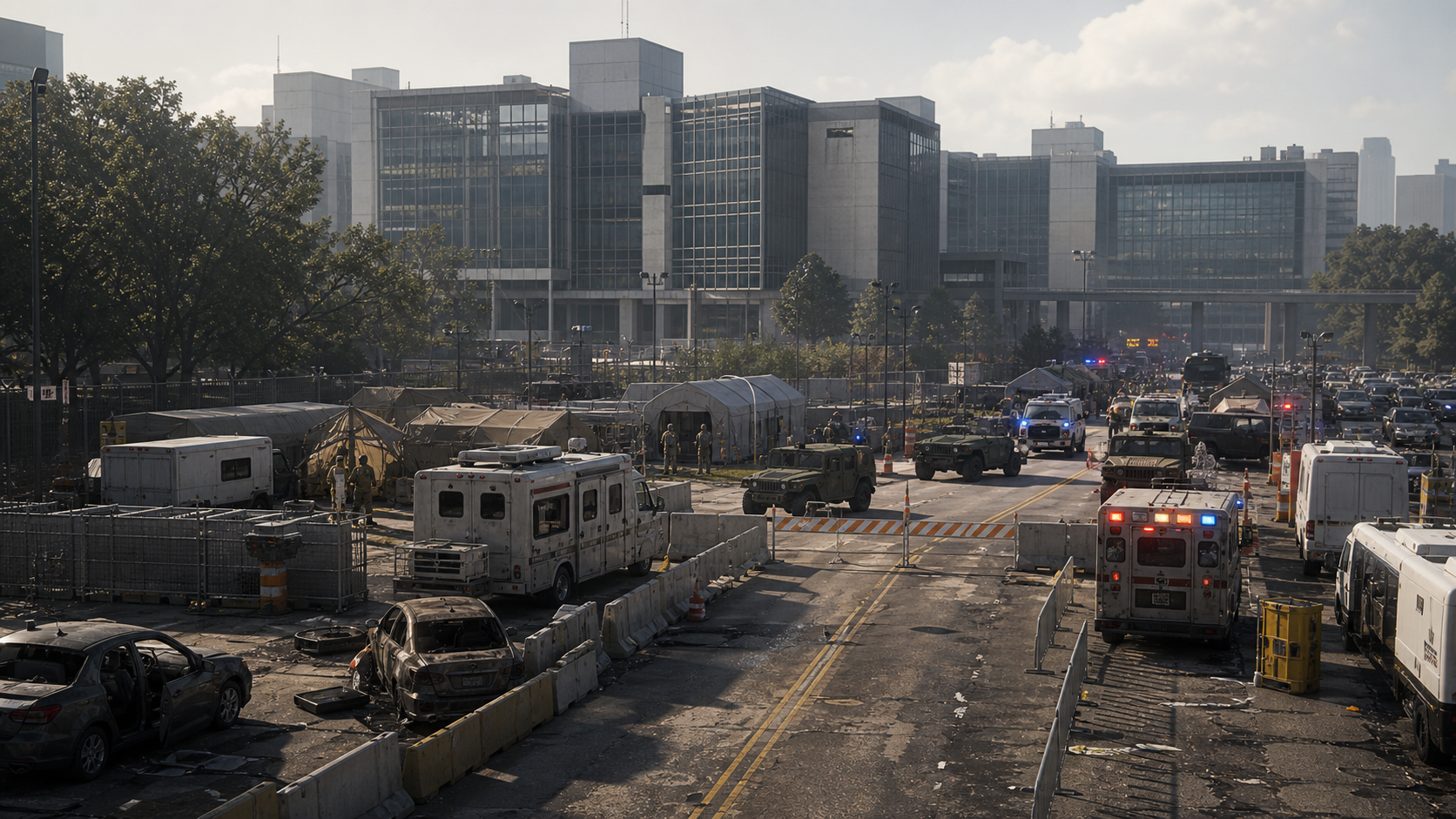
The Atlanta CDC extraction mission is Team Ghost's evacuation of Dr. Michael Allen, Dr. Kate Lovato, Dr. Pat Ellis, and their research group from the Centers for Disease Control and Prevention during the fourth day of the Hemorrhage Virus outbreak in Extinction Horizon. Reed Beckham, Parker Horn, and Alex Riley fly from Fort Bragg with Ellis to the Arlen Spector building after an infected airline passenger brings the outbreak into Atlanta and reports confirm transmission in nearly every major American city.
Quick Facts
- Role
- Missions and Operations
- Aliases
- atlanta-cdc-extraction-mission
Overview
The operation turns from a planned helicopter pickup into a close-quarters rescue when roads around the twelve-story building are blocked, security personnel have transformed, and infected people enter the CDC complex. The scientists and soldiers then have thirteen minutes to reach the aircraft before the Air Force begins firebombing Atlanta. Assistant Kurt is killed during the final run, and Michael Allen is bitten in the right arm. Allen chooses to leave the helicopter rather than carry the infection to safety, entrusting Kate with the work that will produce VariantX9H9.
Mission information
- Field: Type; Detail: Emergency scientific-personnel and research extraction
- Field: Date; Detail: April 21, 2015, Day 4 of the outbreak
- Field: Location; Detail: Arlen Spector CDC building and surrounding streets, Atlanta, Georgia
- Field: Field leader; Detail: Master Sergeant Reed Beckham
- Field: Team Ghost personnel; Detail: Reed Beckham, Parker Horn, and Alex Riley
- Field: Scientific liaison; Detail: Dr. Pat Ellis
- Field: Principal evacuees; Detail: Dr. Michael Allen and Dr. Kate Lovato
- Field: Other laboratory personnel; Detail: Kurt and remaining members of the CDC group
- Field: Air support; Detail: Black Hawk extraction crew, call sign Echo 4 during the escape
- Field: Strategic objective; Detail: Preserve the scientists, samples, and research needed to understand the virus at Plum Island
- Field: Time limit; Detail: Thirteen minutes from the underground lab before scheduled Air Force bombing
- Field: Principal threats; Detail: Infected guards and civilians, congested streets, breached laboratories, limited exits, and imminent firebombing
- Field: Casualties; Detail: Kurt is killed; Michael Allen is bitten and remains behind to prevent further transmission
- Field: Outcome; Detail: Kate, Ellis, Beckham, Horn, and Riley escape; Atlanta is bombed; Kate becomes the principal surviving scientific lead
Background
The CDC team enters the outbreak with more information than ordinary civilians but without a complete explanation. Kate works in a high-containment environment beneath a city whose residents initially continue ordinary routines. Michael is her mentor and a respected virologist. Ellis is part of the same scientific network and has already been pulled into the military response.
Samples and reports from Africa, Chicago, Building 8, and other locations show that the disease is not behaving like a conventional Ebola outbreak. The virus spreads through blood and bodily fluids while producing rapid anatomical and behavioral changes. Victims do not simply become incapacitated. They become fast, violent, predatory, and capable of inflicting new exposures.
Kate also receives the crisis personally. Her brother Javier is caught in the spreading disaster, and their communication makes his probable transformation immediate rather than statistical. She reaches the extraction already grieving and already aware that the work in front of her may be the only way to give his death meaning.
Fall of Atlanta
The outbreak reaches Atlanta through an infected passenger aboard an aircraft. The event demonstrates why airport screening and city-specific containment are no longer viable. A person can travel during incubation or early symptoms, enter a dense transportation hub, and create multiple chains before authorities recognize the form of the threat.
Reports place the virus in Atlanta, New York, Las Vegas, San Francisco, and virtually every other major city. The national situation changes the meaning of the CDC. It is no longer only a headquarters coordinating regional response. It is one of the last concentrations of scientists and research infrastructure capable of producing a countermeasure.
Military command orders the Atlanta team moved to Plum Island, where high-containment laboratories and surviving security can support continued work. Kate initially resists because the group has barely begun analysis and abandoning the lab may mean losing equipment and cultures. Ellis emphasizes that Atlanta is no longer defensible.
Team Ghost assignment
Beckham, Horn, and Riley have already been moved between outbreak missions with little rest. When Ellis tells them Atlanta has fallen, they are ordered into what appears to be an escort operation. Horn questions when Team Ghost became an evacuation detail. Beckham's answer reflects the unit's changing role: command uses them for whatever task is most important, and preserving the scientists may matter more than destroying a target.
Ellis accompanies the operators because he knows the team and can identify the scientific personnel and material. The mission fuses the military and laboratory story lines. Neither group can solve the crisis alone. The scientists cannot reach a secure facility through transformed crowds; the soldiers cannot design a weapon from what they see in the field.
Approach to the Arlen Spector building
Atlanta is already in chaos when the Black Hawk arrives. Cars cover the roads with almost no open pavement, eliminating the planned landing options. Scattered civilians run through the streets, abandoned Humvees surround the gated CDC entrance, and the apparent absence of guards suggests the building's security has failed.
The Arlen Spector building rises twelve stories above the target area, but the research spaces and routes the team needs are constrained by interior corridors and underground levels. A rooftop pickup cannot simply collect scientists who remain below, and the helicopter cannot hold safely over streets filling with infected people.
Beckham identifies a workable insertion and leads the group inside. The operation immediately becomes a building-clearance problem. Former guards and other infected people occupy approaches designed to keep ordinary threats outside. Doors, desks, stairwells, and security checkpoints slow the rescuers while providing the creatures concealment.
Contact with the scientists
The operators reach the laboratory area and find Michael, Kate, Kurt, and the remaining group behind a door struck repeatedly by infected attackers. Beckham identifies Michael and announces the evacuation. The scientists' first instinct is to shelter in place. They have provisions and a high-containment environment, while opening the door means moving directly through the threat.
Beckham then reveals the constraint unknown to them: the Air Force will begin dropping a massive payload on Atlanta in thirteen minutes. Remaining in the lab is not a long-term survival plan. The building is inside a target city, and the national strategy has already shifted toward destruction of urban infection centers.
The team cannot search for an alternate route or wait for infected movement to decline. Beckham's plan is direct: open the door, use suppressing fire to create a lane, move the scientists to the surface, and reach the helicopter before the strike. The group must accept that every minute spent debating reduces the margin for a wounded or slower evacuee.
Breakout from the laboratory
When the door opens, Beckham, Horn, and Riley use controlled fire to clear the immediate corridor. The scientists follow behind the weapons rather than dispersing through the building. The arrangement gives them protection but creates a compact group that can be trapped by an attack from the rear.
Michael and Ellis understand enough of the infection to answer questions while moving, but their knowledge remains provisional. Incubation estimates and symptom descriptions are being revised in real time. Beckham cannot base tactics on a guaranteed window between exposure and transformation.
The group reaches the stairwell with approximately nine minutes remaining. Horn takes point, Riley works ahead and later covers the rear, and Beckham remains close to the civilians. Kate stays with Michael, Ellis, and Kurt. Physical conditioning becomes a survival factor: armed operators can move faster than scientists who have spent the crisis in a laboratory, yet abandoning the slower group would defeat the objective.
Lobby and exterior run
The lobby provides a view of the main exit and the lawn where the Black Hawk can land. It also exposes the group to infected movement from interior rooms and the street. Riley covers the rear, Horn leads through the broken doors, and Beckham coordinates the run toward the aircraft.
The helicopter's arrival is salvation and a new source of noise. Rotor wash, gunfire, and moving people attract infected attackers. The group cannot form a static perimeter because the bombing clock continues. They must cross open ground while the aircraft remains vulnerable at low altitude.
Kurt falls behind with Michael and Ellis. A transformed former soldier drops to all fours, leaps, and lands on Kurt. It tears into his abdomen and neck before the rescuers can reverse direction. Kurt's death is both a loss and the unchosen diversion that allows others to reach the helicopter.
Michael Allen's exposure
Michael is almost at the aircraft when another former soldier tackles him and bites his right arm. Beckham shoots the attacker and drags Michael to the helicopter. The rescue creates a containment crisis inside the very vehicle intended to preserve the research team.
The outbreak has already shown that exposure can progress quickly and that transformed people retain the strength to kill at close range. Michael knows that remaining aboard could infect Kate, Ellis, Team Ghost, the crew, and eventually Plum Island. There is no reliable treatment and no time to isolate him before the aircraft leaves the bombing zone.
He asks for or receives a pistol and makes his own decision. Michael tells Kate that she will have a chance to save the world but that killing a monster will require creating one. He then jumps from the hovering helicopter onto the lawn. Infected people close around him, and a faint gunshot marks his final act.
Michael's choice differs from the abandonment of a casualty. Beckham physically gets him aboard, and Kate asks him not to leave. Michael chooses containment after understanding the bite. The others survive because he refuses to turn their loyalty into another transmission chain.
Extraction and bombing
The Black Hawk clears Atlanta with Kate, Ellis, Beckham, Horn, and Riley. Kurt and Michael are left behind, and the Air Force strike begins against a city that still contains uninfected people as well as transformed populations. Tactical success therefore occurs inside strategic catastrophe.
The evacuation preserves the core expertise needed at Plum Island. Samples, data, and the scientists' combined knowledge can now be placed inside a defended laboratory system. The mission does not save the CDC as an institution or Atlanta as a city. It saves enough of the research community to continue the work elsewhere.
Scientific consequences
Michael's death makes Kate the principal surviving scientific lead in the central countermeasure effort. Ellis remains her partner, but Michael's mentorship and authority can no longer shield her from the decision. She must determine what kind of engineered agent can stop the outbreak and then live with its human cost.
His last warning foreshadows VariantX9H9. The synthetic counter-virus is the monster Kate creates to kill the monster produced by VX-99 and the Hemorrhage Virus. It saves uninfected humanity while killing most infected hosts. Michael does not provide the finished design, but his words identify the ethical form the solution will take.
The mission also establishes the field-laboratory cycle used throughout the series. Operators recover scientists and specimens; scientists turn evidence into countermeasures; military units then acquire materials and deploy the result. Every stage depends on people from the other side of the relationship.
Kate Lovato
Kate leaves Atlanta after losing Javier, Kurt, Michael, her workplace, and the assumption that science will operate as ordinary medicine. Her later bond with Beckham begins in a mission where he protects her body while she inherits responsibility for everyone his team cannot save.
Reed Beckham
Beckham's leadership expands beyond special operations targets. He must explain the firebombing deadline, move untrained civilians, kill former soldiers, and accept Michael's voluntary sacrifice. The mission helps teach him that preserving one scientist may be strategically more important than a conventional combat victory.
Pat Ellis
Ellis becomes the bridge who brings Team Ghost to his colleagues and then continues the work with Kate. He survives Kurt and Michael, a burden that shapes his later willingness to test Kryptonite on himself.
Horn and Riley
Horn and Riley supply the point, rear security, and fire discipline that allow the civilian group to move. Their role demonstrates why Team Ghost's apparently simple escort assignment requires elite operators once the building falls.
Operational significance
The extraction succeeds because the team changes objectives without losing purpose. A safe landing becomes a ground insertion; shelter in place becomes a timed breakout; a personnel pickup becomes a containment decision; and a rescue of Michael becomes preservation of the people he chooses not to endanger.
The mission is also one of the last moments in which national force is used to save a scientific group from a city immediately before that city is deliberately burned. The contradiction captures the outbreak strategy: preserve irreplaceable knowledge, then destroy terrain that can no longer be held.
Important connections
- Michael Allen: CDC team leader and Kate's mentor, bitten during extraction and voluntarily left behind.
- Kate Lovato: Evacuated scientist who inherits leadership of the countermeasure effort.
- Pat Ellis: Scientific liaison and later co-developer of the principal weapons.
- Reed Beckham: Team Ghost leader responsible for the timed ground rescue.
- Parker Horn and Alex Riley: Operators who secure the route and helicopter movement.
- Kurt: CDC assistant killed during the final exterior run.
- Plum Island: Destination where the survivors continue the research.
- VariantX9H9: Counter-virus foreshadowed by Michael's final warning.
- Atlanta firebombing: Strategic deadline that turns the extraction into a thirteen-minute escape.
Chronology and consequences
- Extinction Horizon, early outbreak chapters - Kate and Michael's CDC work, Javier's crisis, spread to Atlanta, Fort Bragg briefing, Team Ghost insertion, laboratory breakout, Kurt's death, Michael's sacrifice, and evacuation.
- Later Extinction Horizon - Plum Island research, specimen chain, Patient 14, VariantX9H9, and Operation Depletion.
- Extinction Age and Extinction Evolution - Long-term consequences for Kate, Ellis, Beckham, and the continuing soldier-scientist partnership.
Continue Exploring
Connected Universe
Books and Stories
Characters
Locations, Events, and Lore
Sources
- Extinction Horizon, Extinction Horizon - Prologue
- Extinction Horizon, Extinction Horizon - Chapter 1