
Science, consequence, and responsibility
Kate Lovato, Science, and Moral Risk
How Kate Lovato’s countermeasures, moral responsibility, scientific uncertainty, personal losses, and partnership with Reed Beckham shape the Extinction Cycle.
·
Category: Characters and Relationships
Kate Lovato is not simply the scientist who helps save humanity. She is the character who has to decide what saving humanity can morally require when time, evidence, consent, and certainty have all collapsed. Her story turns the Extinction Cycle's science into a problem of responsibility: who is accountable when a countermeasure becomes a weapon, when the weapon works imperfectly, and when the person making the decision has people she loves standing inside the blast radius?
Spoiler warning: Full spoilers follow for the original Extinction Cycle and Extinction Cycle: Dark Age.
The most important thing to understand about Kate Lovato is what she did not do.
She did not create VX-99.
She did not design the Vietnam-era super-soldier program that transformed Lieutenant Trevor Brett and his men.
She did not decide that an old military compound should be resurrected at Building 8.
She did not cause Dr. Medford's hidden experiments to escape.
When the outbreak begins, Kate is a scientist trying to understand a catastrophe whose crucial history has been hidden from her. Early in Extinction Horizon, she presses for basic answers about VX-99 and discovers that the people now depending on science do not actually know enough about the material that created the crisis. Team Ghost is sent to retrieve samples because records have been destroyed and institutional knowledge has been compartmentalized.
Kate enters the disaster as an investigator.
She becomes morally complicated when she decides that investigation is no longer enough.
Her defining scientific act is VariantX9H9, a countermeasure engineered to exploit the biology of the infected. She authorizes its completion because the species is running out of time. It kills infected test subjects. It gives military leadership a weapon that can be deployed at enormous scale. It also fails to kill everyone.
The survivors matter.
Eight years later, Dark Age makes the consequence explicit. Kate still carries guilt for the weapon she created. The countermeasure had been designed to kill the monsters produced by X9H9. It killed most, but the survivors became the Variant lineage that continued to plague the world.
That is the center of Kate's moral risk.
Her science is not villainous.
It is necessary.
And necessity does not erase consequence.
The Scientist Inside a Military Apocalypse
The Extinction Cycle divides survival labor between people who generate knowledge and people who buy time for that knowledge to matter.
Reed Beckham and Team Ghost repeatedly enter the places Kate cannot safely go.
Kate repeatedly gives Beckham and the surviving military something more valuable than another rifle: a better explanation of the enemy.
That arrangement looks clean from a distance.
Soldiers fight.
Scientists solve.
The books spend the entire series showing why it is not clean at all.
Kate's experiments require live specimens, which means soldiers have to capture creatures that can kill them. Her countermeasures require ingredients and infrastructure, which means teams have to conduct retrieval missions. Her laboratory conclusions influence deployments, which means scientific uncertainty becomes battlefield risk. Military secrecy can limit what she knows. Military command can decide how her work is used.
The result is a scientific character who is never safely isolated from violence.
The violence happens because of the research.
The research happens because of the violence.
Kate lives at the point where the two systems meet.
First Moral Problem: Science Without the Whole Truth
Kate's first crisis is epistemic before it is ethical.
She cannot act responsibly if the institutions around her do not tell her what they know.
The early outbreak is full of missing information. VX-99 has a classified history. Building 8 has been conducting dangerous work outside the knowledge of many of the people who will later be asked to stop the result. Military and scientific command have fragmented records, old loyalties, hidden facilities, and personnel such as Gibson and Wood whose relationships to the original program are not immediately transparent.
Kate's reaction to this secrecy is important.
She does not treat classification as an excuse to stop asking questions.
She wants to know what VX-99 is, what Medford used, how the infection reached Chicago, and what the biological mechanism may be.
This creates the first principle of her character:
Scientific responsibility begins with refusing to pretend uncertainty is knowledge.
That principle becomes more important later because the temptation to declare success gets stronger as the world becomes more desperate.
The Decision to Create VariantX9H9
The decisive moment in Extinction Horizon comes when Kate's research produces a possible countermeasure.
Her team observes that the synthesized virus can attach to the altered endothelial cells associated with the infection. The automated system can finish creating the weapon.
Kate hesitates.
That hesitation is not weakness.
It is one of the most morally important pauses in the original series.
Once she authorizes the machine, the project changes category. She is no longer merely characterizing the pathogen. She is intentionally creating an agent meant to kill organisms carrying the infection.
The apocalypse makes the argument for action brutally simple.
If she waits, the infection continues spreading.
If she acts, she may kill enormous numbers of people whose bodies have already been transformed by the Hemorrhage Virus.
The book does not let her hide from what that means.
After Patient 14 dies, Kate understands that she has built a weapon capable of killing not thousands, not millions, but potentially billions of infected human beings.
That recognition is crucial.
She does not celebrate.
She becomes nauseated.
Her moral imagination stays active even while the military classifies the test as success.
That difference between operational success and moral success defines her for the rest of the saga.
Were the Infected Still People?
This is where the series puts Kate and Reed on opposite sides of one of its hardest questions.
Reed is capable of seeing the infected as monsters because he encounters them as predators tearing apart his friends.
Kate sees that too.
But she also sees them strapped to tables.
The laboratory changes the visual grammar.
A Variant charging through a hallway is an enemy.
A restrained infected girl called Patient 14 is also a subject.
Kate's discomfort is therefore not abstract bioethics imported from the old world. It is a direct response to the fact that scientific research requires her to preserve categories the war wants to erase.
Was Patient 14 still a person?
The series never offers a simple legal ruling.
Kate's response is emotionally unstable because the answer has practical consequences. If she thinks too much about who the patients used to be, killing them becomes unbearable. If she thinks of them only as monsters, experimentation becomes easier and potentially more dangerous.
At one point she actively tries not to imagine their former identities.
That is an ethical compromise in itself.
Not because detachment is evil, but because detachment is how she remains functional.
War changes what emotional survival requires from scientists just as it changes soldiers.
Reed Beckham as Moral Counterweight
Reed and Kate become central to one another because they understand different sides of the same decision.
Reed does not need Kate to teach him that death is serious.
He needs her to explain what the enemy is becoming.
Kate does not need Reed to tell her science matters.
She needs him to remind her that the people being saved are real.
Their early mutual respect is built before romance dominates the relationship.
After Team Ghost returns with an infected child for study, Beckham thinks about Kate as someone who handled Atlanta with the composure of a soldier and who may be capable of stopping the nightmare. Kate, meanwhile, increasingly wants Reed present during dangerous scientific moments because his presence makes her feel safer and because she knows the specimens and data exist only because soldiers risked themselves to obtain them.
This creates an unusual relationship.
They are not simply scientist and bodyguard.
Each validates the other's form of courage.
Reed acts in physical space.
Kate acts in uncertainty.
Both can get people killed.
Both have to make decisions before they know enough.
"You're Saving Everyone." "Am I?"
One of the most revealing exchanges in the series comes when Reed tries to reassure Kate about VariantX9H9.
His argument is practical. The infected are no longer functioning as ordinary humans. They are predators. If he became one, he says, he would want to die.
Kate's response is essentially a question: is creating a weapon that kills the infected the same thing as saving everyone?
That gap matters.
Reed sees the immediate alternative.
Kate sees the chain of consequences.
Neither perspective is sufficient alone.
A moral system based only on Kate's hesitation may fail to act fast enough.
A moral system based only on Reed's battlefield certainty may fail to examine what the action creates next.
Their relationship works because the books refuse to make either discipline completely sovereign.
The Patient 12 Problem: When the Weapon Does Not Kill Everyone
Patient 14 dies.
Patient 12 does not.
This is the point where Kate's scientific success becomes evolutionary risk.
The surviving patient shows recovery rather than the expected terminal effect. The result does not mean the countermeasure was useless. Far from it. The weapon remains devastating to infected populations.
But evolution does not care that a weapon works on most targets.
The survivors become the future.
Dark Age later gives Kate's guilt a direct vocabulary. She remembers that VariantX9H9 was intended to destroy the monsters created by X9H9. It killed most, but the surviving population changed into the Variants that continued to plague the world.
This does not make Kate morally equivalent to the people who created VX-99.
Intent matters.
Context matters.
Available alternatives matter.
But outcome matters too.
Her story refuses the comforting idea that good intention plus emergency necessity equals moral innocence.
Kate saves humanity from one extinction curve while helping create the biology of the next war.
That is not a contradiction the books resolve for her.
She carries it.
Moral Responsibility Is Distributed, Not Solitary
It would be inaccurate to tell Kate's story as though she personally controls every step of weaponization.
She does not.
The series repeatedly separates scientific development from deployment authority.
Kate designs.
Ellis collaborates.
Military personnel secure specimens and materials.
Command approves operations.
General Kennor and other leaders decide how weapons will be delivered.
Colonel Wood pressures the scientific timeline and controls military resources.
This distributed system matters for moral analysis because responsibility is distributed too.
Kate is responsible for what she creates and what risks she knowingly accepts.
She is not solely responsible for every aircraft, strike plan, political decision, or military deployment.
At the same time, the separation can become morally dangerous because every actor can point elsewhere.
The scientist can say deployment belongs to the general.
The general can say the weapon was certified by the scientists.
The politician can say there was no alternative.
The operator can say he followed orders.
The Extinction Cycle repeatedly shows how catastrophe thrives inside those gaps.
Kate's strength is that she rarely allows the institutional chain to erase her personal sense of accountability.
Her weakness is that she often takes on more responsibility than any one person can realistically bear.
Kryptonite: The Second Countermeasure Is More Targeted, Not Morally Simple
Extinction Age moves Kate's research toward a different concept.
The Variants possess extraordinary healing and immune capabilities. Kate and Ellis identify a possible vulnerability in the rapidly active stem-cell and immune-cell systems supporting that resilience.
Their answer is nicknamed Kryptonite.
The core idea is targeted delivery of existing chemotherapeutic drugs using antibodies. Instead of inventing an entirely new destructive agent from scratch, they attempt to direct cancer drugs toward the cellular systems that make Variants so difficult to kill.
This is a more targeted scientific strategy.
It is not an ethically clean one.
The experiments are still intended to kill living infected subjects.
Patient 3 is restrained on a gurney while a protected medical operator administers the treatment. Kate explains that the goal is to shut down the Variant's immune and healing capacity.
When Wood demands a simpler explanation, Kate's answer is blunt.
They will die.
Fast, she hopes.
That line matters because it shows how much Kate has changed.
The scientist who felt sick after Patient 14 has not become indifferent.
She has become harder.
The catastrophe has trained her to compress the moral problem into the objective when the situation requires it.
Human Testing Under Extinction Conditions
Kryptonite creates another compressed ethical dilemma: safety in uninfected humans.
The normal scientific answer would involve extensive staged testing.
The apocalypse does not offer that luxury.
Ellis injects himself.
The text presents the act as a voluntary self-test, not a covert experiment imposed on him by Kate. That distinction should remain clear. The moral issue is not that Kate violates Ellis's consent.
The moral issue is that the scientific system has become so compressed that self-experimentation by a key researcher becomes part of the path toward population-scale deployment.
One successful volunteer does not establish universal safety.
Everyone in the room knows there is no time to create the evidence base the old world would have demanded.
This is one of the central ethical patterns in Kate's story:
The emergency does not remove scientific standards. It forces people to decide which standards they can afford to violate.
That is a much harder question.
Time Becomes an Ethical Variable
Kate's decisions cannot be judged honestly without including time.
A slow answer may be scientifically cleaner and morally worse if billions die while the study continues.
A fast answer may save millions and create consequences that last decades.
This is why "she should have tested longer" is incomplete.
Longer compared with what?
How many cities fall during the extra week?
How many specimens can the military capture?
How many researchers are still alive?
How long does the electrical grid remain functional?
How many laboratories can still manufacture anything?
The apocalypse turns time into a moral cost.
Kate's brilliance is partly her ability to work inside that compression.
Her trauma is partly the knowledge that every shortcut leaves something unknown.
Operation Liberty Proves That Scientists Can Be Ignored Too
Kate's moral burden also comes from decisions she does not control.
Operation Liberty is a military catastrophe. Later command discussion makes clear that General Kennor ignored warnings from Lieutenant Colonel Jensen and Kate Lovato.
Thousands die.
That event complicates the idea that scientists hold dangerous power.
Sometimes their greatest danger is not overreach.
It is being disregarded.
Kate spends the series moving between two opposite institutional failures:
Science given too much authority without accountability.
Science denied influence when evidence threatens the preferred plan.
The first can create a bioweapon disaster.
The second can send armies into a threat they do not understand.
Her role is therefore not "science is always right."
It is "evidence has to remain inside the decision."
The Raven Rock Mission: When Her Work Sends Reed Back Into Danger
Kate's relationship with Reed becomes morally significant when her scientific needs create his tactical missions.
In Extinction Age, the Kryptonite project requires chemotherapeutics.
Those drugs exist in quantity, but they are not sitting safely next to Kate's laboratory bench.
Someone has to retrieve them.
Reed leads a strike element toward Raven Rock.
Kate feels responsible.
She tells him her work killed billions and created monsters and that he is going back into danger because of what she needs now.
Reed pushes back.
He would be going into danger anyway.
If the drug works, the mission could end the crisis.
This exchange shows why their relationship is not merely romantic decoration.
Reed helps distribute moral weight back into reality.
Kate sees the chain that begins in her laboratory and ends with soldiers under fire.
Reed reminds her that the chain includes their agency too.
He chose the mission.
His men chose their roles.
The apocalypse does not belong entirely to her.
The Airstrike Scene: Science, Love, and Triage
The most powerful intersection of Kate's roles occurs when Reed may have been exposed to infected blood.
Her emotional response is panic.
Her professional response is clinical.
She asks about symptoms.
She tells him to stay away from the others.
An airstrike carrying her bioweapon is already inbound.
If Reed is infected, the weapon may kill him.
The scene collapses every abstraction in her story.
"Population-scale countermeasure" becomes the man she loves.
"Quarantine protocol" becomes ordering Reed away from his friends.
"Successful deployment" becomes the possibility that she will kill him with something she created.
Kate does not stop the operation.
That is the moral importance of the scene.
She does not choose Reed over everyone else simply because she loves him.
But the series also does not pretend the choice is emotionally neutral.
The scientist and the woman occupy the same body.
She has to function as both.
Pregnancy Changes the Meaning of Risk
By Extinction End, Kate is pregnant.
This changes the emotional architecture of the war.
She is no longer thinking only about whether Reed returns to her.
She is thinking about whether their child will have a father.
At the same time, her own body becomes a site of strategic vulnerability. During the attack on Plum Island and her captivity in New York, she is a scientist whose knowledge matters to the war, a pregnant woman trying to protect her unborn child, and a prisoner being carried by the enemy she has spent months studying.
The image is deliberately cruel.
Kate has spent the series turning monsters into data.
Now the monsters physically carry her.
Her work cannot protect her from becoming prey.
That reversal is one of the clearest reminders that science in the Extinction Cycle is powerful but never omnipotent.
Operation Condor and the Ethics of the Specimen
Operation Condor succeeds in capturing a live juvenile specimen.
From a scientific perspective, this is extraordinary.
The enemy has evolved.
A live specimen can reveal information that tissue samples cannot.
From a military perspective, the cost is severe. Team Ghost and the Variant Hunters succeed where other strike teams fail, and the wider operation loses enormous manpower.
Kate's scientific need therefore has a casualty shadow.
Again, it would be simplistic to say the deaths are "her fault." She does not command the operation.
But the books consistently make scientific breakthroughs expensive in human terms.
Someone has to capture the thing the scientists need.
Someone has to fly the aircraft.
Someone has to defend the island.
Someone has to transport the specimen.
Science is not happening behind the war.
It is one of the reasons the war takes particular shapes.
Aftermath: The Scientist Who Cannot Believe in Final Victory
When the immediate Variant crisis appears to ease, ordinary survivors understandably want to believe the nightmare is ending.
Kate cannot.
She worries that the Hemorrhage Virus remains in places the countermeasures did not reach. Rural pockets. Ships. Hidden infected populations. Regions beyond reliable surveillance.
This is not pessimism for its own sake.
It is the scientific consequence of knowing the limitations of the deployment.
A countermeasure does not become universal because leaders declare victory.
Kate's vigilance makes her useful.
It also makes peace harder for her to inhabit.
The public can say, "We survived."
Kate's mind keeps asking, "What did we miss?"
That question becomes prophetic in Dark Age.
Eight Years Later: Marriage Does Not End the Experiment
Dark Age gives Kate something the original books almost never allow her to have.
Routine.
She lives with Reed Beckham and their eight-year-old son, Javier Riley, near Outpost Portland on Peaks Island. She drinks coffee. She watches the water. She lives in a safe zone protected by advanced sensors, soldiers, sailors, and hidden defenses.
She and Reed are married.
This matters because their relationship survives beyond emergency attraction.
They make it into reconstruction.
But Kate's guilt also survives.
Peaks Island reminds her of Plum Island, the place where she helped design the countermeasure that still haunts her. The rebuilt world does not absolve her simply by existing.
President Ringgold has told Kate that she did what she had to do to save humanity.
Kate still carries the burden.
That is one of the strongest things Dark Age does with her character.
It refuses to equate historical success with emotional exoneration.
Kate as Mother, Scientist, and Public Asset
The rebuilt world also changes Kate's institutional role.
She is no longer merely one exhausted scientist inside an emergency laboratory.
She is a nationally important expert.
When new threats emerge, she receives military escort. Her team is large enough to staff a lab around the clock. Her work takes place inside an infrastructure that can again support controlled experiments, computational analysis, cell culture, and collaboration.
That sounds like progress.
It is.
It also means the state again knows exactly how important her mind is.
Kate becomes a protected asset.
That creates its own tension.
Security allows her to work.
Security also reduces privacy.
Her family receives protection others do not.
She feels guilty about that privilege when other parents are dying.
The moral risk of the Dark Age is no longer only "what should the scientist create?"
It is also "what does society owe the scientist whose work may save it, and what does that protection cost everyone else?"
Dark Age Science: Kate Has Learned to Change Her Mind Faster
The later Kate is a more mature scientist.
One of her defining Dark Age strengths is methodological flexibility.
When the team studies red webbing, Alpha tissues, unusual growth patterns, and cancer markers, existing hypotheses fail to explain the organized structures found in the tunnels.
Kate does not cling to the failing model.
She redirects the experiment.
She pushes for different assays.
She considers whether the tissue is being actively directed rather than merely growing chaotically.
This is the positive scientific legacy of everything she survived.
The first war taught her that nature, engineered biology, and human interference can produce outcomes nobody predicted.
Dark Age Kate is therefore less interested in defending the elegance of the current explanation.
She wants the explanation that fits the evidence.
OrgoProct and the Return of Old Guilt
The OrgoProct investigation is where Kate's old moral burden becomes scientifically relevant again.
Her team finds evidence suggesting that Chimera tissues contain signatures associated with a gene-delivery system linked to an old effort to reverse VX-99 and X9H9 effects.
The timing is disturbing.
OrgoProct's final report was sent shortly before Kate developed VariantX9H9.
Kate proposes a possibility: what if her countermeasure interacted negatively with the other gene therapy?
The text is careful.
Kate says it is a theory.
That is important.
The ethical lesson is not that she instantly confesses to "creating the Chimeras."
The lesson is that she is willing to place her own past work inside the causal hypothesis.
She does not protect herself from investigation.
That willingness is one of the strongest markers of her scientific integrity.
Moral Risk Is Not the Same as Moral Failure
The phrase "moral risk" matters because it is more accurate than "guilt."
Kate makes decisions that can cause enormous harm.
That does not mean the decisions are obviously wrong.
VariantX9H9 may have created a surviving lineage of stronger threats.
It also kills huge numbers of infected at a moment when humanity is approaching extinction.
Kryptonite requires lethal live-subject experimentation.
It also offers a more targeted path against a biology that conventional weapons struggle to defeat.
Operation Condor costs soldiers.
It also gives science access to the juvenile stage that may otherwise remain incomprehensible.
Moral risk means acting when every option can produce unacceptable consequences.
Kate's greatness as a character comes from the fact that she never becomes comfortable with that.
She becomes capable of it.
That is different.
Kate and Reed: Two Forms of Responsibility
Reed and Kate ultimately survive because their ethical instincts are complementary.
Reed's moral universe is built around duty to people in front of him.
Who is trapped?
Who needs extraction?
Who is covering the rear?
Who does he refuse to leave behind?
Kate's moral universe is built around consequences that may not be visible yet.
What happens after deployment?
What does the survivor population become?
What biological reservoir remains?
What does this intervention select for?
What unknown mechanism explains the evidence?
Reed protects the present.
Kate worries about the future.
Reed can be too willing to carry risk personally.
Kate can be too willing to carry blame personally.
Together, they keep interrupting those extremes.
He reminds her she is saving actual people.
She reminds him that winning the immediate fight is not the same as understanding what the fight creates.
A Relationship Built on Professional Trust Before Domestic Peace
The later marriage works because the earlier relationship is not built only on attraction.
They trust one another's competence.
That is a stronger foundation in this universe than romantic idealization.
Kate knows Reed will go back into danger.
She hates it.
She also knows that telling him to stop being the person who goes would mean asking him to stop being himself.
Reed knows Kate will keep working even when the science hurts her.
He cannot solve that pain by ordering her away from the lab.
Their relationship is therefore not about eliminating risk.
It is about living honestly with the other's reason for accepting it.
That remains true in Dark Age.
Reed is pulled toward politics and operations again.
Kate returns to dangerous biological research.
Their family gives them more to lose, not less reason to act.
The Personal Cost of Being Necessary
Kate's scientific importance repeatedly takes away ordinary choices.
She cannot simply evacuate like everyone else.
She cannot stop working because she is tired.
She cannot entirely disappear into motherhood after the first war.
She cannot treat Reed's missions as someone else's problem.
She cannot experience new Variant evidence without wondering whether her own work is part of the explanation.
The Dark Age lab can operate twenty-four hours a day partly because Kate finally has a larger team.
Even then, she feels guilty when she rests.
That detail may be one of the most psychologically revealing facts about her.
The emergency becomes internal.
Even when other people can take the shift, Kate's mind tells her she should be there.
That is what prolonged responsibility does.
It makes delegation feel like abandonment.
Scientific Heroism Without Scientific Innocence
Kate Lovato is one of the most interesting scientific characters in post-apocalyptic fiction because the series refuses to make intelligence morally cleansing.
She is smart.
She is compassionate.
She is brave.
She saves lives on an almost unimaginable scale.
And her most important scientific intervention has unintended consequences that survive for years.
Those facts coexist.
The story would be weaker if it decided one canceled out the other.
If VariantX9H9 only saved humanity, Kate would become a simple genius-savior.
If it only created worse monsters, she would become another scientist-who-played-God cautionary figure.
Instead, it does both.
That is why her guilt matters.
It is not proof that she was wrong.
It is proof that she understands the cost of being right under catastrophic conditions.
Kate's Decision Timeline
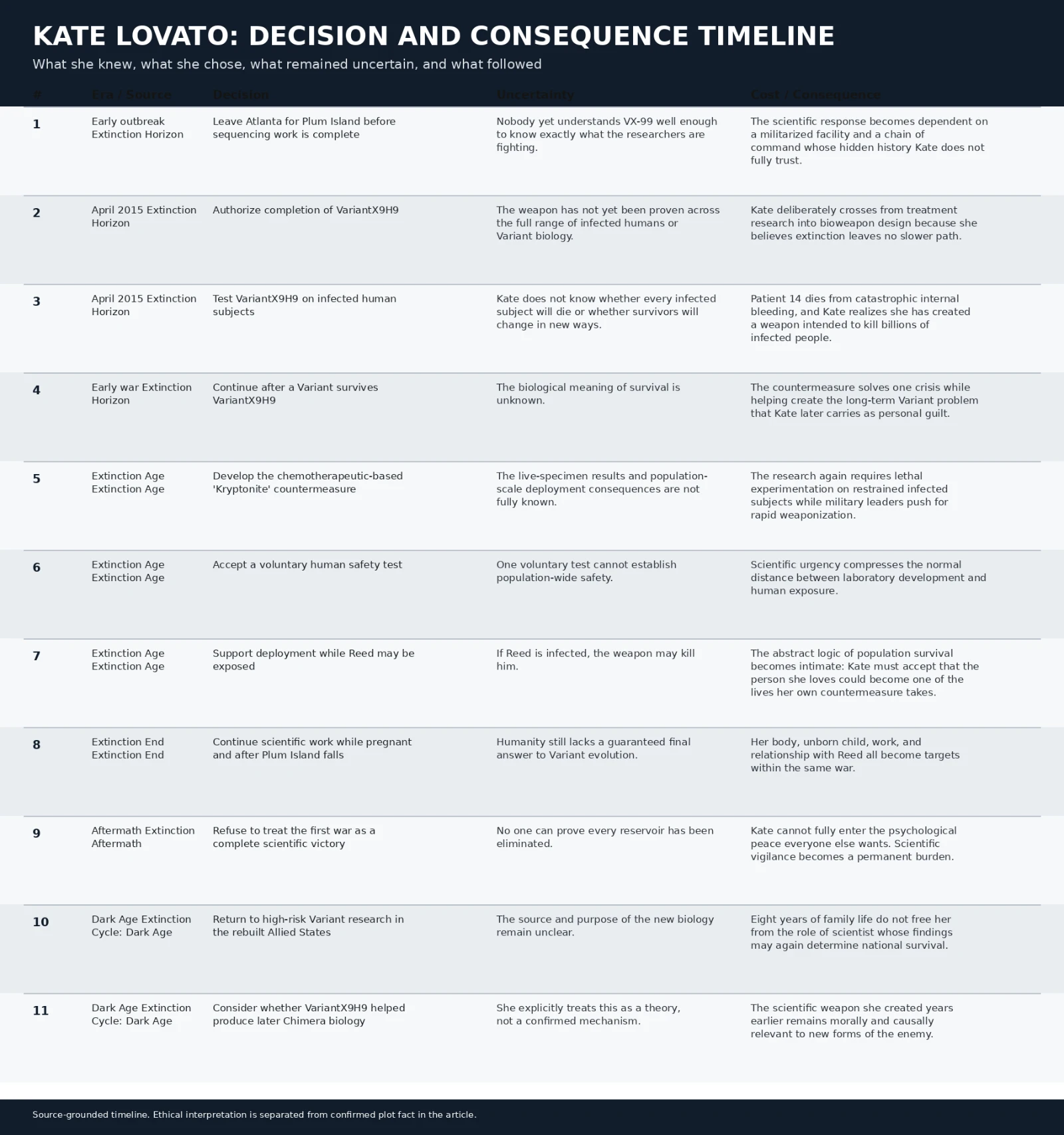
| # | Era | Scientific or moral decision | Primary risk | Source |
|---|---|---|---|---|
| 1 | Early outbreak | Leave Atlanta for Plum Island before sequencing work is complete | Institutional | Extinction Horizon |
| 2 | April 2015 | Authorize completion of VariantX9H9 | Scientific | Extinction Horizon |
| 3 | April 2015 | Test VariantX9H9 on infected human subjects | Human-subject ethics | Extinction Horizon |
| 4 | Early war | Continue after a Variant survives VariantX9H9 | Unintended consequence | Extinction Horizon |
| 5 | Extinction Age | Develop the chemotherapeutic-based 'Kryptonite' countermeasure | Weaponization | Extinction Age |
| 6 | Extinction Age | Accept a voluntary human safety test | Human testing | Extinction Age |
| 7 | Extinction Age | Support deployment while Reed may be exposed | Personal | Extinction Age |
| 8 | Extinction End | Continue scientific work while pregnant and after Plum Island falls | Personal and institutional | Extinction End |
| 9 | Aftermath | Refuse to treat the first war as a complete scientific victory | Postwar responsibility | Extinction Aftermath |
| 10 | Dark Age | Return to high-risk Variant research in the rebuilt Allied States | Renewed scientific burden | Extinction Cycle: Dark Age |
| 11 | Dark Age | Consider whether VariantX9H9 helped produce later Chimera biology | Legacy consequence | Extinction Cycle: Dark Age |
What Kate Learns Across the Series
1. Classified science can create unaccountable risk
The catastrophe begins with hidden military science whose history is not available to the people forced to respond.
Kate never forgets that.
2. A successful countermeasure can change the enemy
VariantX9H9 teaches the most important biological lesson of the series.
Killing most of a population can make the survivors disproportionately important.
3. Human testing does not become ethically simple because extinction is possible
Consent, safety, and evidence still matter.
The apocalypse compresses them.
It does not make them irrelevant.
4. Deployment is part of scientific responsibility even when scientists do not command it
Kate cannot control every military use of her work, but she cannot morally pretend deployment begins outside the boundary of science either.
5. Love makes triage harder but not optional
Reed's possible infection forces Kate to choose professional judgment while emotionally terrified.
6. Guilt can produce vigilance without producing clarity
Kate's willingness to question her own past work is scientifically valuable.
It can also make her assume responsibility for causal chains that remain uncertain.
7. The best scientist in the room still has to change her mind
Dark Age Kate is strongest when evidence pushes her away from the current model and she follows.
Is Kate Responsible for the Variants?
The most accurate answer is:
partly, but not originally and not alone.
VX-99 predates Kate by decades.
The Hemorrhage Virus catastrophe emerges from experiments she did not initiate.
The military, government, hidden programs, scientists such as Medford, and older figures connected to the VX-99 program all form the causal structure that produces the outbreak.
Kate's responsibility begins when she creates VariantX9H9.
Her goal is to destroy the infected threat.
The weapon kills enormous numbers of infected.
The survivors become the long-term Variant problem described later.
That makes Kate part of the causal chain.
It does not make her the origin of the chain.
The distinction is essential.
Was Kate Wrong to Create VariantX9H9?
The series does not provide enough evidence for a clean answer.
That ambiguity is the point.
The alternatives available to Kate are not normal.
She is not choosing between a risky weapon and a safe, proven therapy.
She is choosing between an unproven countermeasure and an extinction process already accelerating around the world.
A responsible analysis therefore has to hold two conclusions simultaneously.
The choice was understandable and likely necessary under the information available.
The unintended consequences remain morally real.
Kate's character lives in the space between those statements.
Why Kate Matters to the Meaning of the Extinction Cycle
Without Kate, the franchise risks becoming a story where every problem can be solved by better soldiers and larger explosions.
Her presence prevents that.
The Variants are biological.
The response has to be intellectual as well as tactical.
But Kate also prevents the opposite simplification.
Science is not automatically the humane alternative to war.
Her laboratory can become a weapon factory.
Her experiments can kill.
Her discoveries can send soldiers into danger.
Her countermeasures can reshape evolution.
The books use her to argue something much more difficult:
Knowledge is power, and power does not stop being morally dangerous because the person holding it is trying to save the world.
That is the central idea of Kate Lovato.
Final Verdict
Kate's legacy is not that she finds a perfect cure.
She never gets that luxury.
Her legacy is that she keeps thinking when everyone around her needs certainty faster than science can honestly provide it.
She acts.
She doubts.
She revises.
She grieves.
She keeps working.
She loves Reed without turning him into an exemption from the rules she believes protect everyone else.
She raises a son in a rebuilt world while knowing some of the monsters outside that world exist partly because of a decision she made to keep humanity alive.
And when new evidence suggests the old decision may still be shaping the enemy, she does not look away.
That is scientific responsibility in the Extinction Cycle.
Not purity.
Not innocence.
Responsibility.
The willingness to make a terrible decision when there may be no good one.
The willingness to study what that decision created.
And the willingness to remain accountable long after everyone else has decided it is time to call the war over.
Quick Takeaways
Kate did not create VX-99. She inherits a catastrophe created by older military-scientific programs.
Her defining countermeasure is VariantX9H9. It kills most infected targets but has long-term unintended consequences.
Kryptonite is a second, more targeted approach. It uses antibodies to deliver chemotherapeutics against Variant healing and immune biology.
The experiments carry real ethical cost. Restrained infected patients are used in lethal testing, while Ellis later performs a voluntary human safety test.
Science and military force are inseparable in her arc. Soldiers capture specimens and retrieve drugs; Kate's results shape deployments.
Reed is both partner and moral counterweight. Their relationship grows from professional trust into love, marriage, and family.
Dark Age does not erase her guilt. Eight years later she remains haunted by VariantX9H9 while continuing to lead research against new threats.
Her greatest strength is not certainty. It is the willingness to change the hypothesis when evidence demands it.
FAQ
Did Kate Lovato create VX-99?
No. VX-99 was a military bioweapon program that predates Kate's role in the outbreak by decades. Kate becomes involved after the modern Hemorrhage Virus catastrophe begins.
What did Kate Lovato create?
Her most important early countermeasure is VariantX9H9, a weaponized virus designed to target cells altered by the Hemorrhage Virus. She later helps develop the chemotherapeutic-based countermeasure nicknamed Kryptonite.
Why does Kate feel guilty about VariantX9H9?
The weapon kills most infected targets, but Dark Age material explicitly states that survivors became the Variants that continued to plague the world. Kate carries guilt over those unintended consequences years later.
What is Kryptonite in Extinction Age?
Kryptonite is the nickname for a targeted antibody system intended to deliver chemotherapeutic drugs into the Variant biological systems responsible for extreme healing and immune resilience.
Did Kate test Kryptonite on healthy humans?
Pat Ellis voluntarily injects himself during the testing process and survives. The text presents this as a self-test under extreme wartime pressure, not as Kate secretly experimenting on him.
How does Kate's science affect Reed Beckham?
Her research repeatedly determines the missions Reed must undertake, including specimen acquisition and retrieval of materials. In one of the clearest personal conflicts, Reed may have been exposed to infected blood while an airstrike carrying Kate's bioweapon is inbound.
When do Kate and Reed become a family?
By Extinction End, Kate is pregnant. In Dark Age, eight years after Extinction War, Kate and Reed are married and live near Outpost Portland with their son, Javier Riley.
Does Kate stop doing research after the first war?
No. In Dark Age she continues working as a high-priority scientist, studying Alpha tissues, webbing, new cellular behavior, and the origins of later Variant forms.
Did Kate create the Chimeras?
The reviewed text does not confirm that. Kate develops a theory that VariantX9H9 may have interacted with another gene-delivery effort associated with OrgoProct. She explicitly treats the idea as a theory that requires testing.
Is Kate a scientist or a bioweapons developer?
She becomes both, unwillingly and under extinction conditions. Her original role is scientific investigation, but the emergency pushes her into designing countermeasures that are deployed as weapons.
Editorial Disclosure
This is an independent fan analysis of a fictional scientist and fictional biotechnology. It is not medical or biological guidance. The fictional countermeasures do not reflect real-world treatment or bioweapons science.
Recommended next pages
Sources and editorial scope
- Canon treatment
- Source-grounded character analysis that distinguishes Kate’s actions from the older VX-99 program, preserves uncertainty around her later OrgoProct theory, and separates responsibility from sole causation.
- Spoiler scope
- Full spoilers for the original Extinction Cycle and Extinction Cycle: Dark Age, including VariantX9H9, Kryptonite, Kate and Reed’s family, and later Variant research.