
When biological change becomes the future
Sweet Tooth vs. Extinction Cycle: Is a New Species Humanity’s Future or Its Replacement?
Compare Sweet Tooth and Extinction Cycle through hybrids, Variants, pandemic fear, scientific responsibility, coexistence, and the politics of replacement.
·
Category: Analysis and Opinion

Thesis: Both stories ask whether a transformed future still belongs to humanity, but they answer that question through very different kinds of biological change, moral panic, and survival politics.
Spoiler and Scope Note
This article is a speculative comparative analysis. It is not a claim of official crossover canon. The Extinction Cycle discussion is grounded in recurring canon themes, while the outside-franchise side is treated as a thematic comparison rather than a scene-by-scene recap.
Introduction: Two Apocalypses, Two Definitions of the Future
A comparison between Sweet Tooth and Extinction Cycle immediately moves beyond the usual monster- versus-monster framework. Both settings are post-apocalyptic, both are haunted by disease, and both are deeply concerned with what humanity becomes after a biological rupture. Yet the central emotional question in each franchise is radically different. Sweet Tooth asks whether humanity can accept a future in which children embody a transformed species, while Extinction Cycle asks whether humanity can survive a future in which evolutionary change has been weaponized against it. That difference matters because it changes what fear looks like, what heroism looks like, and what rebuilding is supposed to accomplish.
In Sweet Tooth, the existence of hybrids turns children into symbols of both hope and threat. The biological event does not simply produce dangerous enemies. It produces successors, innocents, and moral mirrors. Societies collapse partly because adults cannot decide whether the transformed future should be protected, feared, studied, or destroyed. Extinction Cycle moves in the opposite direction. Variants are not misunderstood heirs waiting to be integrated into a new social compact. They are fast, lethal, organized, and progressively more adaptive enemies. Humanity is not debating coexistence from the start. It is trying to survive annihilation.
That contrast gives this speculative article its center. If Sweet Tooth is about fear of replacement, Extinction Cycle is about organized resistance to extinction. If Sweet Tooth forces characters to confront whether humanity deserves to retain its old place at the top of the moral order, Extinction Cycle forces its characters to defend the possibility of any moral order at all. Comparing the two therefore reveals more than two sets of creatures. It reveals two entirely different survival philosophies. One is asked to rethink humanity. The other is asked to protect it under military conditions.
Pandemic Origins and the Meaning of Biological Catastrophe
Both franchises emerge from biomedical catastrophe, but the narrative emphasis lands in different places. In Sweet Tooth, the collapse is wrapped in mystery, grief, and spiritual unease. The pandemic and the appearance of hybrids feel like entwined events that destabilize ordinary explanations. Even when science enters the conversation, the series resists allowing biology to settle the deeper moral problem. People want a clean story in which a disease arrived, a cure can be found, and normal life restored. But hybrids undermine that desire because they are not merely symptoms. They are living beings whose existence forces adults to ask whether the old definition of normal deserves to return.
Extinction Cycle is far more direct about scientific causation and institutional culpability. Building 8, VX-99, and the Hemorrhage Virus place human agency at the center of disaster. The apocalypse is not a metaphysical crisis disguised as a pandemic. It is a catastrophe made worse by state power, secrecy, militarized science, and the assumption that biological engineering can be controlled. This lets Extinction Cycle treat its outbreak as a strategic and moral failure at once. The biological event is terrifying, but the betrayal behind it is equally important.
That distinction changes how survivors interpret the world around them. In Sweet Tooth, characters often live with ambiguity. The hybrid child can become a site where wonder, dread, guilt, and hope all overlap. In Extinction Cycle, ambiguity exists too, but the primary battlefield remains concrete: intelligence, countermeasures, safe zones, tactical adaptation, and the hunt for survival. A transformed being is evaluated first through the lens of threat. That does not mean the books ignore ethics. It means ethics arrive under fire.
For readers, the result is a fascinating inversion. Sweet Tooth worries that the future may belong to beings humans refuse to understand. Extinction Cycle worries that the future may disappear because powerful institutions transformed biology into a war zone. In one series, the disease unsettles human identity. In the other, it mobilizes human violence.
Hybrids vs. Variants: New Life or New Predation?
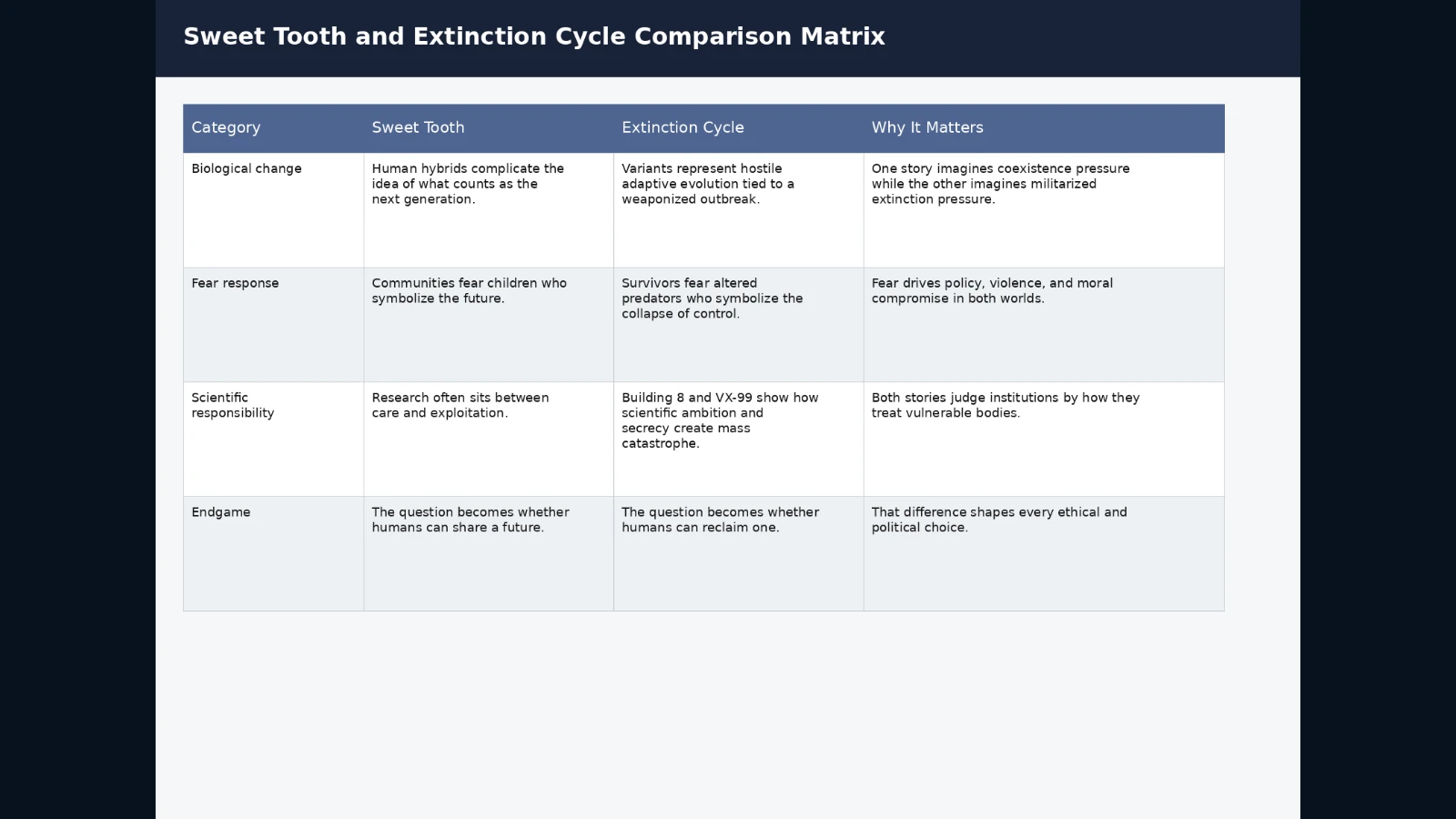
The most obvious point of comparison is biological change itself. Sweet Tooth hybrids and Extinction Cycle Variants both occupy the narrative space of transformed humanity, but they do so in almost opposite ways. Hybrids are children, often physically vulnerable, emotionally legible, and morally central. They destabilize adult societies because they cannot be reduced to a simple enemy category. Variants, by contrast, are predators shaped by acceleration, brutality, and tactical escalation. They are terrifying not because they blur innocence and monstrosity, but because they make human defenses obsolete faster than ordinary outbreak fiction usually allows.
That contrast immediately changes how a settlement or military unit behaves. A Sweet Tooth community that encounters a hybrid is forced into a judgment about empathy, prejudice, and the future. The question becomes: are we witnessing contamination, miracle, or evolution? An Extinction Cycle outpost does not normally get that interpretive delay. When Variants appear, the survival calculus is instant. They move fast, strike hard, and punish hesitation. A delayed decision is often a fatal one. That means the moral space around the transformed body is much narrower in Extinction Cycle.
Yet this does not make the comparison shallow. In both franchises, transformed bodies become tests of what human civilization values. Sweet Tooth asks whether people can protect vulnerable life even when that life makes them uncomfortable. Extinction Cycle asks whether civilization can remain moral while fighting a form of life that has become implacably hostile. Both worlds therefore fear a loss of humanity, but in different registers. Sweet Tooth fears that panic will make humans betray the next generation. Extinction Cycle fears that relentless war will harden people into permanent emergency thinking.
If one pushes the comparison further, the franchise divide becomes even sharper. Hybrids are symbols of continuity through difference. Variants are symbols of rupture through adaptation. One invites coexistence arguments. The other invites containment, combat, and the grim recognition that not every evolution is compatible with shared survival.
Scientific Responsibility: Curiosity, Exploitation, and Countermeasures
Science occupies a morally unstable position in both stories. In Sweet Tooth, scientists and researchers hover between care and exploitation. Their work can be motivated by desperation, compassion, fear, or institutional pressure. Because the hybrid child is not merely an infection vector but a person, scientific inquiry cannot remain morally abstract. Every attempt to study the new world risks turning vulnerable life into a tool. The ethical question is therefore intimate: when does the search for answers become abuse?
Extinction Cycle places scientific responsibility inside a harsher architecture of state secrecy, defense priorities, and emergency warfare. Building 8 is the clearest example. Research is not just compromised by fear. It is entangled with military logic and national-security thinking from the beginning. The consequences are catastrophic. Kate Lovato and other scientifically positioned characters matter because they represent the possibility that science can still serve life rather than domination. Yet even the best countermeasure work takes place under pressure, limited information, and impossible tradeoffs.
This is where the two settings productively overlap. Both suggest that science cannot be evaluated only by its stated intention. It has to be judged by the conditions in which it operates and by the people whose bodies bear the cost. In Sweet Tooth, the cost is often borne by children who symbolize a future adults cannot control. In Extinction Cycle, the cost is borne by soldiers, civilians, infected populations, and entire regions transformed into testing grounds of survival. The moral failure is not science alone. It is science detached from accountability.
That insight makes the comparison richer than a simple cure debate. Saving humanity sounds noble in both franchises, but each story asks what kind of humanity is being saved and at whose expense. When institutions start speaking about the species in the abstract, individuals become expendable. Sweet Tooth and Extinction Cycle both resist that move, though in different tones. One does so with sorrowful compassion. The other does so through crisis ethics and battlefield realism.
Coexistence or Total War?
Perhaps the single biggest difference between Sweet Tooth and Extinction Cycle lies in whether coexistence is imaginable. In Sweet Tooth, coexistence is not only imaginable but morally unavoidable. The transformed future is embodied in beings who must be protected if any ethical civilization is to survive. The obstacle is prejudice, fear, opportunism, and the inability of adults to relinquish a vision of humanity that places themselves at the center. Coexistence is hard, but it remains the story’s moral horizon.
Extinction Cycle rarely begins with coexistence as a viable option. Variants are organized around aggression and domination. Their evolution is not merely a difference to be understood. It is an escalating military challenge. Humanity’s first task is to keep from being exterminated. That makes the social atmosphere harsher. Settlements form around defense plans, patrols, perimeter discipline, logistics, and command coherence. The war footing is not an overreaction. It is often the bare minimum needed to stay alive.
Still, the comparison is not simply hopeful world versus violent world. Extinction Cycle also exposes the costs of making total war your baseline condition. Trust narrows. Civil liberties become fragile. Scientific work is militarized. The meaning of reconstruction becomes tangled with who gets to define safety. Sweet Tooth, meanwhile, shows that the language of coexistence can be betrayed by people who sentimentalize the future without protecting real bodies. In both cases, the central issue is whether fear controls the political order.
If a Sweet Tooth character were inserted into Extinction Cycle, they would likely be shocked by how little room there is for interpretive generosity. If an Extinction Cycle operator were inserted into Sweet Tooth, they might initially misread hybrids through a purely threat-based framework. That speculative mismatch is the point. It reveals how survival worlds train perception. Some worlds make you ask whether strangers are the future. Others make you ask whether strangers are the reason there may be no future left.
Leadership and Community Legitimacy
Leadership in Sweet Tooth often succeeds when it protects the vulnerable and rejects panic politics. Legitimacy comes not just from competence, but from moral restraint. Communities that cannot control their fear of hybrids become brittle, cruel, and self-defeating. The best leaders therefore act as interpreters of a frightening new reality. They calm, include, and defend. Their authority grows when they prove that protection can extend beyond the familiar definition of the human.
Extinction Cycle rewards a different first-stage leadership profile. Reed Beckham and other tactical leaders gain legitimacy because they can make fast decisions under pressure, use intelligence well enough to keep others alive, and hold units together during cascading emergencies. That is a real form of moral leadership, but it is rooted in performance under fire. Communities trust leaders who can secure perimeters, choose missions wisely, and understand that a failed operation can doom an outpost or settlement.
The speculative challenge comes when those models extend into long-term governance. Sweet Tooth assumes that the future cannot be morally rebuilt by force alone. Extinction Cycle knows force is necessary but also increasingly exposes its limitations when reconstruction begins. A team built for raids, recovery, and crisis response is not automatically built for legitimacy politics, inclusion, or institution building. The books often understand this tension clearly. Military competence can stabilize a broken environment, but it can also reach its ceiling.
This is why the comparison matters. Sweet Tooth asks whether leadership can teach people to accept a changed future. Extinction Cycle asks whether leadership can prevent the future from being destroyed long enough to argue about what it should look like. Those are related but not identical problems. One tests ethical imagination. The other tests organized resilience.
Fear of Replacement and the Question of Humanity
The title question of this article is not rhetorical. Is a new species humanity’s future, or its replacement? Sweet Tooth lives inside that question. Hybrids trigger adult terror because they make human centrality feel temporary. Parents, governments, militias, and researchers all respond to the possibility that the next world may not look like the last one. The fear is not only biological. It is civilizational. If the future speaks with a different face, are old institutions still entitled to rule it?
Extinction Cycle processes replacement differently. Variants are not ambiguous heirs but existential antagonists. Yet the fear they generate is still partly about replacement. Not replacement through coexistence, but replacement through supersession. What if a faster, deadlier, more adaptive form of life simply outcompetes humanity? The survival panic is therefore less philosophical at first, but no less intense. Humanity is forced to confront the possibility that it is no longer the dominant species in practical military terms.
These fears produce different moral temptations. Sweet Tooth tempts societies toward exclusionary purity politics. Extinction Cycle tempts societies toward permanent emergency militarization. Both temptations shrink the moral imagination. In one case, the transformed child becomes a scapegoat. In the other, every unknown becomes a tactical risk. Neither is a stable basis for civilization.
What makes both franchises memorable is that they do not let the audience escape this tension easily. They ask whether being human is a biological fact, a moral practice, or a political claim. Sweet Tooth leans toward moral practice. Extinction Cycle begins from biological survival but gradually reopens the moral question through reconstruction, sacrifice, and responsibility. The difference in starting points is vast, but the deeper philosophical pressure is surprisingly similar.
What Would Team Ghost Make of the Sweet Tooth World?
If Team Ghost entered the Sweet Tooth universe, their first challenge would be perceptual. They are trained by the logic of Extinction Cycle, where speed, aggression, and adaptive lethality define the threat environment. Their instincts would initially push them toward threat classification, controlled contact, and perimeter discipline. That part would be valuable. The Sweet Tooth world still contains danger, disorder, and predation. A disciplined team could protect routes, secure communities, and counter hostile actors effectively.
But Team Ghost would also risk importing the wrong assumptions. Hybrids are not Variants. They cannot be ethically approached as if they were simply another mutation on the threat ladder. A leader like Beckham would adapt faster than many because one of his best qualities is not blind aggression but practical judgment under evolving conditions. Once he understood that the transformed children were not battlefield enemies, he would likely redirect his leadership toward protection, transport, and targeted action against those exploiting them.
This hypothetical underscores something essential about Extinction Cycle’s better leaders. Their competence is not valuable because it is inflexible. It is valuable because it can be recalibrated. The danger, however, would come from institutions surrounding them. Scientific secrecy, emergency rules, and fear-based command structures could misread the Sweet Tooth world badly. Team Ghost could become humane protectors, but only if they were allowed to see clearly and operate beyond panic.
That is the best way to frame the crossover thought experiment. Team Ghost would be tactically useful in Sweet Tooth, but only after learning that the central mission is not eradication. It is moral triage in a world where the future looks unfamiliar.
Final Comparison: Future Species or Future Society?
In the end, Sweet Tooth and Extinction Cycle are both survival stories about inheritance. They differ less in whether biology matters than in what biology is made to mean. Sweet Tooth uses transformation to question whether humans can welcome a successor world. Extinction Cycle uses transformation to test whether humans can preserve a world worth inheriting. One fears that the old human order will cling to power too long. The other fears that there will be no human order left if defense fails.
This is why the most honest answer to the title question has to be twofold. In Sweet Tooth, a new species looks like humanity’s future, provided humans can behave ethically enough to survive that transition. In Extinction Cycle, the transformed species appears as a replacement threat, not a successor civilization. The novels are not asking the same moral question, even though both are dealing with evolution, pandemic collapse, and scientific responsibility.
Yet the two franchises illuminate each other. Sweet Tooth reminds Extinction Cycle readers that not every biological change should be processed through militarized fear. Extinction Cycle reminds Sweet Tooth readers that some threat environments leave very little room for interpretive patience. Survival depends on recognizing which world you are actually in. Misread the future, and you become either a cowardly persecutor or a dead idealist.
The deepest connection between the two is therefore not in creatures but in moral timing. When should you defend, when should you protect, when should you include, and when should you fight? These stories give radically different answers because they imagine radically different biological futures. But both insist that the fate of civilization depends on whether people learn those answers before fear becomes irreversible.
FAQ
Are Sweet Tooth hybrids comparable to Variants?
Only as a thematic contrast. Sweet Tooth centers vulnerable hybrid children and the moral question of coexistence, while Extinction Cycle's Variants operate as an escalating existential threat.
What is the comparison really testing?
It tests how institutions decide whether biological change should be protected, studied, contained, or fought—and how fear changes the meaning of humanity.
Is this a canon crossover?
No. It is independent fan criticism comparing established premises from two separate fictional worlds.
Source note
Netflix's official material establishes Gus as a human-deer hybrid, the Sick and Great Crumble, and the conflict over whether hybrids are a cause, consequence, cure, or future. Extinction Cycle claims are checked against current VX-99, Building 8, Variant, Kate Lovato, and reconstruction records.
Editorial note
This independent fan analysis uses original generic artwork and a submitted editorial comparison chart. It does not reproduce official franchise images, actor likenesses, logos, or claim a canon crossover.
Recommended next pages
Source and canon pack
- Canon treatment
- Official Netflix material establishes Gus, hybrids, the Sick, and the Great Crumble. Extinction Cycle science claims follow local records; the moral comparison remains interpretive.
- Primary wiki source plan
- VX-99, Building 8, Variant, Kate Lovato, scientific-responsibility, and reconstruction records provide the Extinction Cycle baseline.
- Spoiler scope
- Broad premise and thematic spoilers for Sweet Tooth plus broad Extinction Cycle biological-threat context, without an episode or ending recap.
- Safety boundary
- Independent transformative fan criticism. No official Sweet Tooth imagery, actors, characters, hybrid designs, sets, screenshots, logos, child distress, medical advice, or claim of canon crossover is published.
- Program article ID
- EC-35
- Scheduled publication
- 2026-08-26T18:26:00-04:00