
When cure logic erases consent
The Maze Runner vs. Extinction Cycle: Bioweapons, Test Subjects, and the Ethics of a Cure
Compare The Maze Runner and Extinction Cycle through WCKD, the Flare, Building 8, VX-99, experimentation, secrecy, consent, and cure ethics.
·
Category: Analysis and Opinion

Thesis: Both franchises build apocalyptic pressure around the promise of a cure, but they reveal how easily the rhetoric of saving humanity turns living people into expendable test subjects.
Spoiler and Scope Note
This article is a speculative comparative analysis. It is not a claim of official crossover canon. The Extinction Cycle discussion is grounded in recurring canon themes, while the outside-franchise side is treated as a thematic comparison rather than a scene-by-scene recap.
Introduction: Saving Humanity and Losing It in the Process
The Maze Runner and Extinction Cycle belong to slightly different apocalyptic registers, but they converge around one of disaster fiction’s hardest questions: how much can institutions take from individuals in the name of saving the species? Both franchises are obsessed with cure logic. They imagine authorities under existential pressure, increasingly willing to strip away consent, transparency, and moral restraint because the alternative looks like civilizational collapse. That setup makes comparison not only possible but revealing.
The Maze Runner concentrates this problem through youth, confinement, and experimental control. WCKD does not merely study a ruined world. It engineers environments and subjects people to them, convinced that brutal means are justified by the possibility of a cure. Extinction Cycle frames the problem through military science, strategic secrecy, and the aftermath of weaponized biological ambition. Building 8 and the broader VX-99 crisis are not simply cure efforts gone too far. They are proof that once institutions merge emergency logic with dehumanizing research, the line between protection and exploitation becomes frighteningly thin.
This article compares the two worlds through bioweapons, test subjects, human experimentation, scientific secrecy, and the ethics of a cure. The goal is not to collapse their differences. The Maze Runner is structured around labyrinthine manipulation, adolescent survivorship, and the pathology of utilitarian thinking. Extinction Cycle is structured around combat readiness, outbreak escalation, Variant evolution, and countermeasure work under battlefield conditions. Yet both end up confronting the same moral trap: if you treat people primarily as inputs into a survival equation, you may preserve the species only by hollowing out the meaning of saving it.
That is why the cure question matters so much. The issue is not simply whether a treatment can be found. It is whether the society pursuing it retains any right to call itself worth saving.
WCKD and Building 8: Emergency Institutions Without Moral Brakes
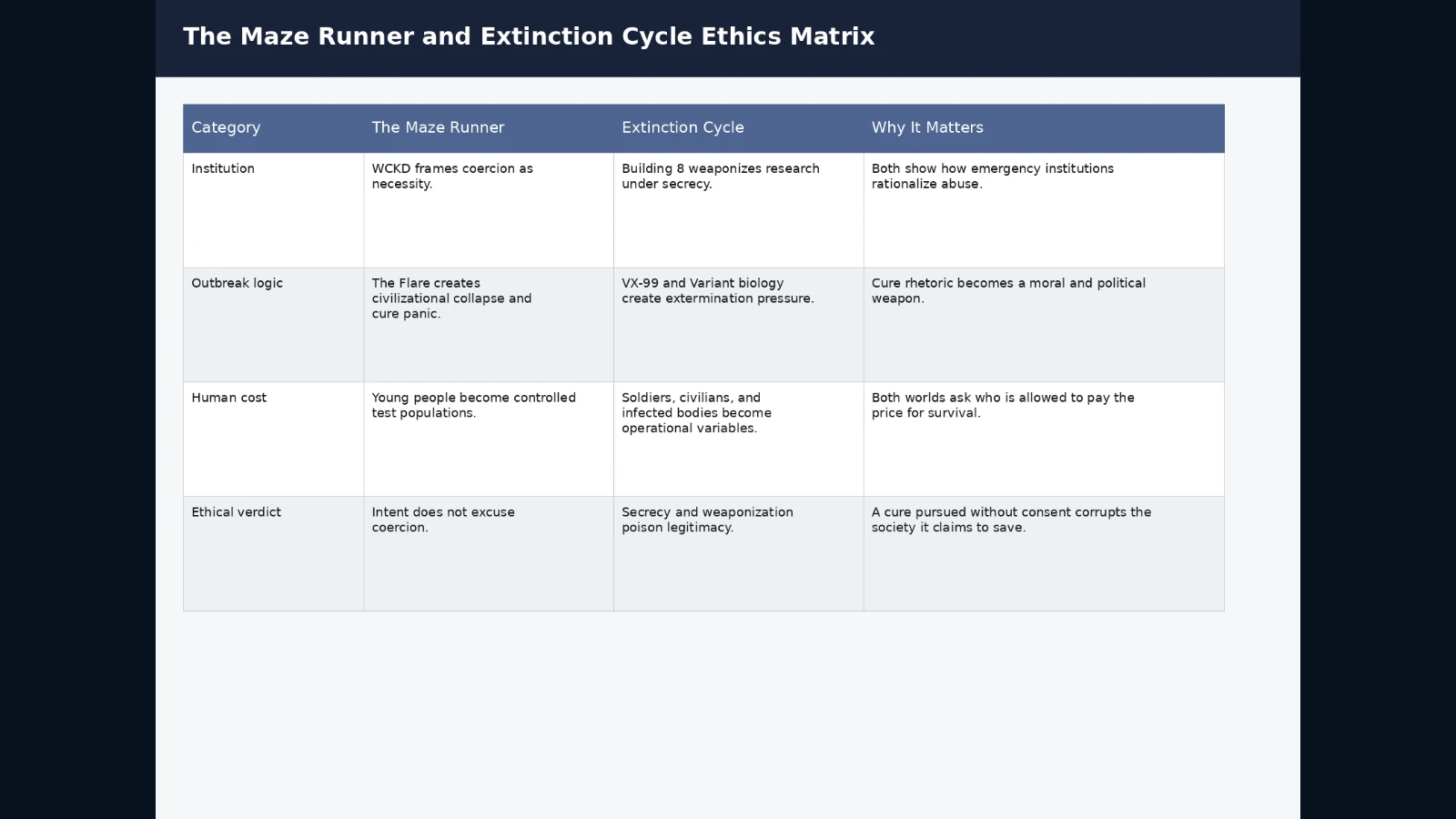
WCKD and Building 8 are compelling to compare because they are not identical versions of villainy. WCKD often presents itself as a necessity engine. It believes the stakes are so high that ordinary ethics have become luxuries the world can no longer afford. That belief gives it its icy confidence. Young people are selected, observed, manipulated, and traumatized under the banner of a future cure. The organization’s language is saturated with grim duty. Suffering becomes not accidental but procedural.
Building 8 operates inside a more explicitly militarized frame. Extinction Cycle is less interested in institutional theater and more interested in the catastrophic consequences of hidden research, biological ambition, and command structures that mistake operational secrecy for wisdom. If WCKD dramatizes utilitarian experimentation in a controlled series of ordeals, Building 8 dramatizes the fallout of state-driven scientific arrogance. The problem is not just that bad things happen behind closed doors. It is that the institutional design already assumes some lives may be spent for strategic ends.
The comparison reveals a shared pathology. Both institutions imagine themselves as occupying a zone beyond ordinary morality. They speak the language of emergency necessity, but what they actually normalize is unaccountable power. That does not mean everyone inside them is identical. Both worlds contain individuals who may act from sincere desperation or who later recognize the horror of the systems around them. But sincerity does not repair structure. A compassionate researcher inside a coercive machine does not erase the machine.
Readers often respond viscerally to this because both stories understand a basic truth: once an institution claims that only it can save humanity, it becomes tempted to redefine humanity in terms of its own project. People stop being neighbors, patients, students, or citizens. They become subjects, variables, or sacrifices. The moral brake fails not at the moment of disaster, but at the moment leaders decide that moral brakes are what disaster requires them to abandon.
The Flare, VX-99, and the Politics of Catastrophic Disease
Disease in both worlds is more than a biological problem. It is a governance problem, a narrative problem, and a justification engine. The Flare in The Maze Runner generates a civilization shaped by desperation, scarcity, and the prospect that cure research may be the only meaningful collective mission left. The disease changes people, destroys stability, and invites extraordinary measures. Yet the franchise’s emphasis remains on what institutions do to people while claiming they are acting against the disease.
VX-99 in Extinction Cycle carries a sharper militarized charge. It is inseparable from the logic of development, weaponization, and loss of control. The virus and the horrors surrounding Variant evolution create pressure not merely to govern panic, but to repel annihilation. This makes the world more tactically intense and more immediately brutal. Human beings are not only at risk of sickness and madness. They are at risk of being outclassed and exterminated by the very biological disaster unleashed into the world.
Still, both diseases operate politically. They turn fear into a resource. Authorities can demand sacrifice, justify secrecy, and narrow public choice by invoking the scale of the threat. This is where the ethical comparison becomes sharpest. The crisis is real, but the language of crisis can be used to suspend accountability. Citizens and subjects are told there is no time for debate, no space for consent, and no alternative to obedience.
What makes both series compelling is that they do not trivialize the scale of the threat. The danger is genuine. But they refuse the comforting lie that genuine danger automatically sanctifies authority. That is a lesson as relevant to fiction as to political thought. A catastrophic disease may require hard decisions, but it does not grant moral innocence to whoever makes them.
Test Subjects, Consent, and the Human Price of Knowledge
The Maze Runner forces the test-subject question into the foreground. Young people are not merely endangered by the world; they are organized into experiments. Their fear, memory loss, stress, and suffering are instrumentalized. That design makes the ethical issue impossible to evade. Whatever WCKD tells itself, its project depends on treating persons as controlled inputs. Consent is not a meaningful condition. It is bypassed or structurally hollowed out.
Extinction Cycle handles the same issue through a more distributed field of harm. Not everyone is a literal subject inside an overt experiment, but the world is full of bodies paying for decisions they never approved. Soldiers are sent into impossible conditions shaped by concealed information. Civilians become collateral to prior scientific ambition. Infected bodies become sites of analysis under pressure. The ethics of testing, exposure, and intervention are never clean because the emergency environment keeps collapsing the distance between laboratory and battlefield.
This produces one of the most revealing contrasts between the two series. The Maze Runner often stages consent as an obvious absence, making institutional abuse easier to identify. Extinction Cycle stages consent as something eroded by secrecy, chain of command, survival urgency, and the collapse of civilian oversight. The result is morally messier but no less serious. People may appear to be participating in necessary missions, yet the conditions shaping those missions were built by institutions that never earned true consent in the first place.
The larger moral point is that knowledge gained through coercion is never ethically neutral. Even if data is useful, the process of extraction matters. A cure built on systematic disregard for persons does not simply solve a problem. It reveals what a society has decided some people are worth. Both franchises invite readers to judge not only outcomes, but the human price that institutions are willing to disguise as necessity.
Scientific Secrecy and the Corrosion of Trust
Secrecy is indispensable to both narratives because it allows institutions to hold on to authority after they have forfeited legitimacy. In The Maze Runner, hidden motives, manipulated environments, and withheld truth intensify the protagonists’ confusion and rage. The system depends on asymmetry. Subjects are expected to endure, react, and reveal useful patterns without ever gaining the full context needed to evaluate what is happening to them.
Extinction Cycle is just as interested in asymmetry, but its costs are often measured in operational failure. When leaders, soldiers, and scientists do not have full truth, missions become riskier, alliances thinner, and crisis judgment more brittle. Reed Beckham’s world repeatedly demonstrates that intelligence gaps are not abstractions. They kill people. Scientific secrecy may protect reputations, institutions, or strategic leverage, but it undermines the coordinated trust necessary for survival.
What links the two worlds is that secrecy does more than hide facts. It changes relationships. It teaches people that loyalty may be exploited, that official language may conceal betrayal, and that appeals to the greater good often arrive after irreversible damage. This corrosion does not vanish once the immediate emergency shifts. It lingers into reconstruction, governance, and memory. A community that has survived catastrophic deceit cannot easily return to uncomplicated trust.
That makes secrecy one of the most politically important elements in both franchises. Readers may focus on monsters, trials, and tactical set pieces, but the deeper social wound is informational. Who knew what, when, and why did they hide it? If the cure question concerns what a society is willing to do, the secrecy question concerns what a society is willing to become while doing it.
Can a Cure Justify Sacrificing Individuals?
This is the core ethical question, and both franchises answer it by testing the reader’s tolerance for utilitarian reasoning. Institutions in both worlds are tempted to argue that extinction-level stakes make ordinary moral categories obsolete. If the species may vanish, what is a handful of lives, a generation of test subjects, or a classified atrocity compared to global preservation? This reasoning is powerful because it appears mathematically serious. Yet both narratives expose its hollowness.
The problem is not that collective survival never matters. Of course it matters. The problem is that a society speaking in the name of survival can lose contact with the persons survival is supposed to protect. Once individuals become expendable units, moral injury ceases to be an exception and becomes a method. The cure ceases to be a rescue and becomes a regime. That is exactly what happens when institutions stop asking not only whether something works, but whether the way it works destroys the community it claims to save.
The Maze Runner makes this especially visible because the sacrificed are young and visibly disempowered. Extinction Cycle widens the lens to show how soldiers, civilians, and researchers themselves can all become trapped inside systems that ration personhood. The series does not pretend that there are painless options. Hard choices are everywhere. But hard choices are not the same as unbounded permission.
If one had to summarize the shared ethical verdict, it would be this: a cure pursued without consent, accountability, and moral restraint may preserve bodies while destroying legitimacy. And a legitimacy vacuum is not a side issue. It determines what kind of civilization exists after the emergency passes.
Field Survival vs. Controlled Experiment: Different Worlds of Competence
One reason the comparison is so rich is that the protagonists in each franchise are shaped by different environments of competence. The Maze Runner’s survivors become skilled at adaptation inside imposed systems. They learn patterns, resist manipulation, form trust networks, and navigate spaces designed to extract behavior from them. Their heroism is partly interpretive. They survive because they notice, infer, and refuse institutional scripts.
Extinction Cycle’s central operators are formed in conditions where interpretation must rapidly become action. Team Ghost and similar actors cannot linger long in analytic suspension. They must identify threats, execute missions, protect civilians, and adapt to fast-changing enemy behavior. Their competence is tactical, logistical, and moral in a distinctly compressed way. Even when information is incomplete, waiting for perfect clarity is rarely an option.
This difference matters when evaluating the ethics of experimentation and cure work. A Maze Runner- style subject may learn to distrust every environment. An Extinction Cycle operator may learn to distrust every hidden agenda. Both are rational responses, but they generate different survival psychologies. One becomes resistant to systems of control. The other becomes resistant to intelligence withholding and command distortion.
In a crossover thought experiment, these competencies would collide productively. Maze Runner protagonists might read Building 8’s secrecy faster than some insiders do. Team Ghost might protect subjects more effectively once the coercive architecture became clear. The broader lesson is that crisis does not create one universal kind of survivor. It creates different literacies. Some people learn to endure being studied. Others learn to survive while fighting the consequences of study.
Kate Lovato, Scientific Conscience, and the Possibility of Ethical Repair
No comparison between cure ethics and Extinction Cycle is complete without noting the importance of figures like Kate Lovato. She matters because she represents a crucial counterpoint to the institutional mindset described above. Not all science in Extinction Cycle is corrupted beyond recognition. The series repeatedly suggests that scientific work can still be morally serious if it is tied to accountability, care, and a refusal to treat human beings as disposable.
That does not make ethical repair easy. Science in a crisis inherits damaged structures. It inherits secrecy, militarization, urgency, and pressure from leaders who want results faster than truth can safely deliver them. Kate’s significance lies partly in how much weight such characters carry when trying to redirect research toward survival without reproducing the abuse that helped create the catastrophe. Their work is not clean because the world is not clean. But they keep open the possibility that science can again serve life rather than systems.
This is a point The Maze Runner also circles, though in a different tone. The possibility of ethical science remains the only real answer to the false binary WCKD presents. If the choice is “accept abuse or let humanity die,” then abuse becomes normal. Both franchises resist that trap by suggesting that the real alternative is not passivity but a different moral architecture for response.
In that sense, the cure question is also a character question. Who gets to embody the conscience of science? Which individuals refuse to let necessity language cancel the dignity of the people being studied? Those figures matter because they show that expertise without ethics is merely efficient harm.
Final Verdict: What These Worlds Teach About the Price of Salvation
The Maze Runner and Extinction Cycle are both haunted by the dream of salvation through science. Yet their deepest warning is not anti-scientific. It is anti-dehumanization. Both worlds show how easy it is for institutions facing extinction to insist that moral compromise is temporary, necessary, and regrettable. But compromise accumulates. Procedures harden. Subjects disappear into categories. And the very people most vulnerable to exploitation are told they should feel honored to serve a greater end.
Extinction Cycle intensifies the warning by showing what happens when cure politics exist inside a militarized ecosystem. The need for countermeasures is real, but so is the temptation to merge truth with command convenience. The Maze Runner intensifies it by making the subjected population impossible to overlook. The children and young survivors at the center of the story force the audience to feel the violence of being instrumentalized.
The most defensible conclusion across both worlds is straightforward. Saving humanity cannot morally mean destroying the status of persons. Individuals may choose sacrifice. They may take risks knowingly. They may fight, endure, and volunteer. But a system that presumes the right to spend them is already corrupted. A cure may matter immensely, yet it does not justify every road taken toward it.
That is why these two franchises belong in conversation. They remind readers that apocalyptic pressure reveals not only what science can do, but what institutions are willing to become while chasing answers. The cure is never just a substance. It is also a test of whether civilization can survive the methods it uses to save itself.
FAQ
Why compare WCKD with Building 8?
They are different institutions, but both reveal how emergency language and secrecy can turn people into variables inside projects supposedly intended to save humanity.
Does the article argue against cure research?
No. It argues that scientific urgency does not erase consent, accountability, or the moral status of the people bearing the cost.
Is this a canon crossover?
No. It is independent fan criticism comparing institutional and ethical themes.
Source note
20th Century Studios' official material establishes WCKD, the Gladers, and the Flare-centered survival setting. Extinction Cycle claims are checked against current Building 8, VX-99, Hemorrhage Virus, Kate Lovato, Team Ghost, and countermeasure records.
Editorial note
This independent fan analysis uses original generic artwork and a submitted editorial comparison chart. It does not reproduce official franchise images, actor likenesses, logos, or claim a canon crossover.
Recommended next pages
Source and canon pack
- Canon treatment
- Official 20th Century Studios material establishes WCKD and the Flare-centered survival setting. Extinction Cycle science claims follow local records; the institutional comparison remains thematic.
- Primary wiki source plan
- Building 8, VX-99, Hemorrhage Virus, Kate Lovato, Team Ghost, countermeasure, and scientific-responsibility records provide the Extinction Cycle baseline.
- Spoiler scope
- Broad institutional and disease-premise spoilers for The Maze Runner plus broad Extinction Cycle science context, without recapping character outcomes.
- Safety boundary
- Independent transformative fan criticism. No official Maze Runner imagery, actors, characters, maze designs, laboratories, screenshots, logos, real medical or experimental instruction, or claim of canon crossover is published.
- Program article ID
- EC-37
- Scheduled publication
- 2026-08-26T18:28:00-04:00