
Engineered life and institutional responsibility
Jurassic World vs. Extinction Cycle: When Scientists Create Predators They Cannot Control
Compare Jurassic World and Extinction Cycle through genetic engineering, containment failure, weaponization, secrecy, public risk, and scientific responsibility.
·
Category: Analysis and Opinion
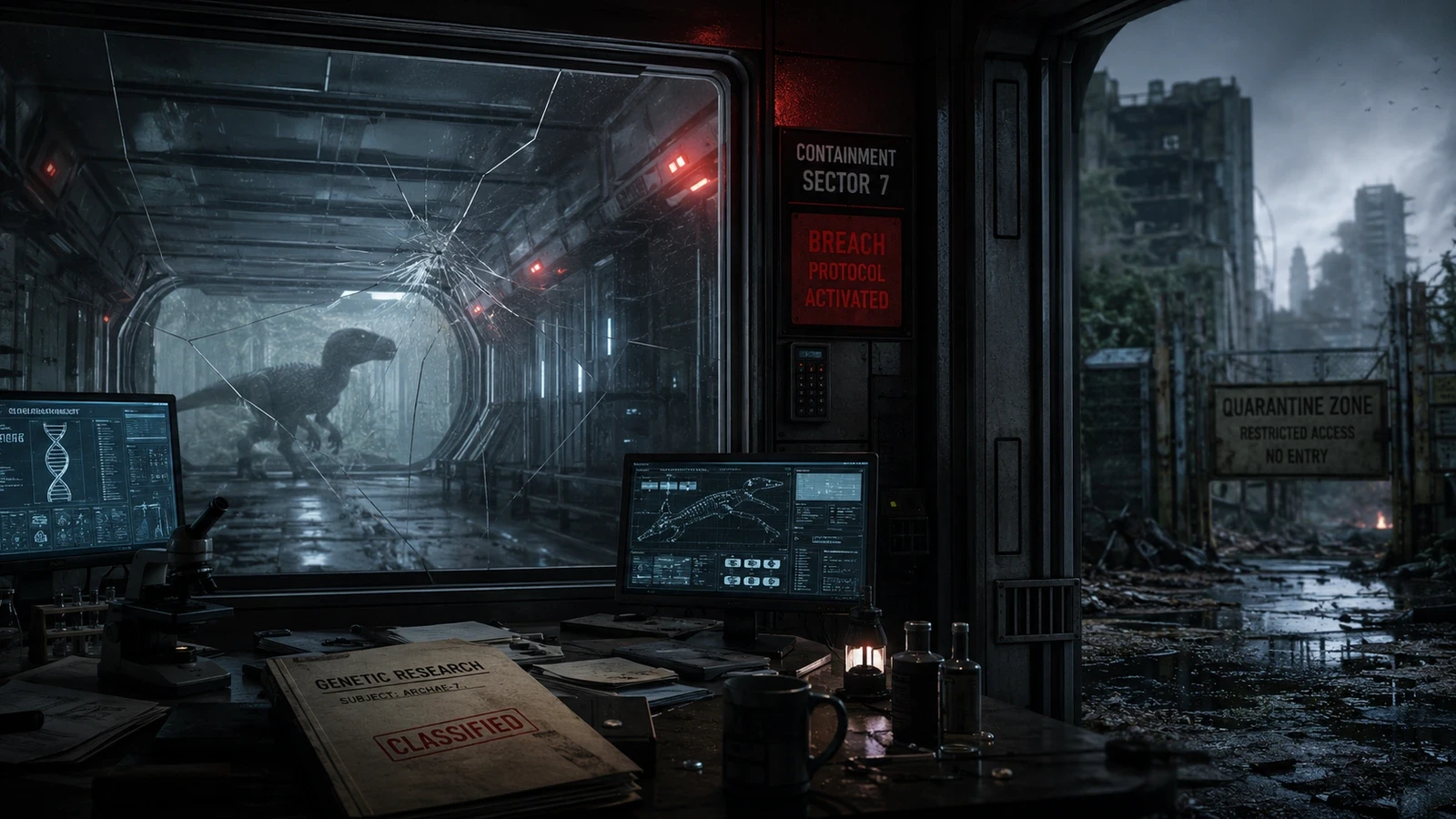
**One franchise begins with a park built on genetic wonder and corporate spectacle. The other begins with military research, bioweapon history and a viral catastrophe that turns human beings into Variants. At first glance, Jurassic World and the Extinction Cycle can look too different to compare directly. Dinosaurs are not infected humans. Theme-park disaster is not post-apocalyptic war. But once you move beneath the creature designs, both stories are asking versions of the same question: what happens when experts and institutions create predators they do not fully understand, then rely on containment, secrecy and optimism to compensate for what they cannot control?**
That question makes the comparison more serious than it might appear.
The overlap runs through five core issues:
- genetic or biological engineering
- containment failure
- weaponization
- institutional secrecy
- the responsibility of scientists after disaster begins
The point is not that the worlds are identical.
The point is that both treat science not as neutral decoration but as a human choice with moral consequences.
The Origin Story Difference Matters
The first contrast between the franchises is motivational.
Jurassic World
The danger begins in a world of spectacle, commerce and controlled wonder. Genetic engineering exists to make the impossible marketable, scalable and in some cases more exciting. Even when the films turn toward hybridization, the logic remains tied to institutional ambition: build something amazing, profitable or useful enough that the risk feels worth rationalizing.
Extinction Cycle
The Extinction Cycle begins from military history and classified research. The danger is not a showpiece predator but a bioweapon lineage. VX-99 and the later Hemorrhage disaster root the series in a harsher moral space. The system was never innocent even when its defenders believed it was manageable. It was always entangled with power.
This makes Extinction Cycle the darker accusation.
Jurassic World says human institutions overreach for profit, prestige and control.
Extinction Cycle says human institutions may overreach for strategic dominance and then lose control of the species-level consequences.
Predators by Design
Both stories become stronger when you realize the predators are not simply "animals" or "monsters." They are design outcomes.
In Jurassic World, that may mean engineered traits, bred expectations or creatures whose behavior was interpreted through what the park operators wanted them to be.
In the Extinction Cycle, design works at the viral and physiological level. The human body itself becomes the site of the experiment's terrible success.
The point in both worlds is the same.
Humans create a system and then tell themselves the system remains legible because they built it.
That belief turns out to be false.
Containment Failure Is Never Just a Broken Fence
Popular summaries of Jurassic World often reduce the crisis to a containment breach. Something got out. Security failed. Chaos followed.
That is true, but incomplete.
Containment in that world is an ideology as much as a physical structure. It rests on the belief that risk is measurable, compartmentalized and governable by procedures. The broken enclosure matters because it exposes a deeper error: the managers believed they understood a living engineered predator well enough to build a business around its behavior.
The Extinction Cycle tells a more militarized version of the same story.
Containment failure is not merely a lab accident or one perimeter collapse. It becomes the failure of every institutional layer that assumed classified biology could be responsibly managed despite incomplete knowledge and moral compromise.
The real breach happens before the doors open.
It happens the moment the institution confuses temporary management with durable control.
Scientists and the Fantasy of Knowing Enough
This is one of the strongest shared themes.
Neither franchise argues that science itself is evil.
Both argue that science inside ambitious institutions can become dangerously overconfident.
In Jurassic World
Scientists and their sponsors often act as though more data equals mastery. But more data is not the same as wisdom. You can understand fragments of a creature's genome, optimize enclosure systems and still fundamentally misread what the creature will do in a live environment.
In the Extinction Cycle
The problem becomes more painful because scientists like Kate Lovato are not the architect of the original VX-99 program. Kate inherits a catastrophe shaped by military research and must decide how to use science inside an emergency that is already morally compromised. The series is strongest when it shows that scientific brilliance cannot erase the consequences of the system she is trying to repair.
That is why the franchises make a useful pair.
One shows the hubris of engineers and institutions creating spectacular predators.
The other shows the burden carried by researchers trying to stop a catastrophe that science also helped shape.
Weaponization: The Trap Behind Both Worlds
Once a dangerous biological creation exists, some institution will imagine using it.
This is true almost by narrative law.
Jurassic World and weapon thinking
The moment a predator is sufficiently impressive, somebody will ask whether it can be trained, directed or deployed. Weaponization may sound absurd to sane observers, but bureaucratic ambition often thrives on absurdity disguised as innovation.
Extinction Cycle and weapon thinking
Weaponization is not a late temptation here. It is close to the story's DNA. Military research, countermeasures and outbreak response all operate inside the logic that biology can be an instrument of strategy.
This is what makes the Extinction Cycle harsher than a simple outbreak novel.
It does not merely show that science can go wrong.
It shows that the desire to turn biology into leverage can poison decisions long before catastrophe becomes public.
Corporate Secrecy vs Military Secrecy
This is one of the cleanest comparison points on the page.
Corporate secrecy in Jurassic World
Information is shaded by branding, liability, commercial presentation and institutional ego. The audience often sees the consequences in terms of delayed honesty and the refusal to fully admit what has been created.
Military secrecy in Extinction Cycle
The stakes escalate. Classified history, partial disclosure, command filtering and strategic concealment shape the response. In this world, secrecy is not just about embarrassment. It is about power, national security and responsibility avoidance.
The common lesson is brutal:
Secrecy turns a solvable danger into a systemic disaster.
The difference is in scale.
Corporate secrecy imperils a park or a chain of events.
Military secrecy can imperil civilization.
Who Is More Responsible: Scientists or Institutions?
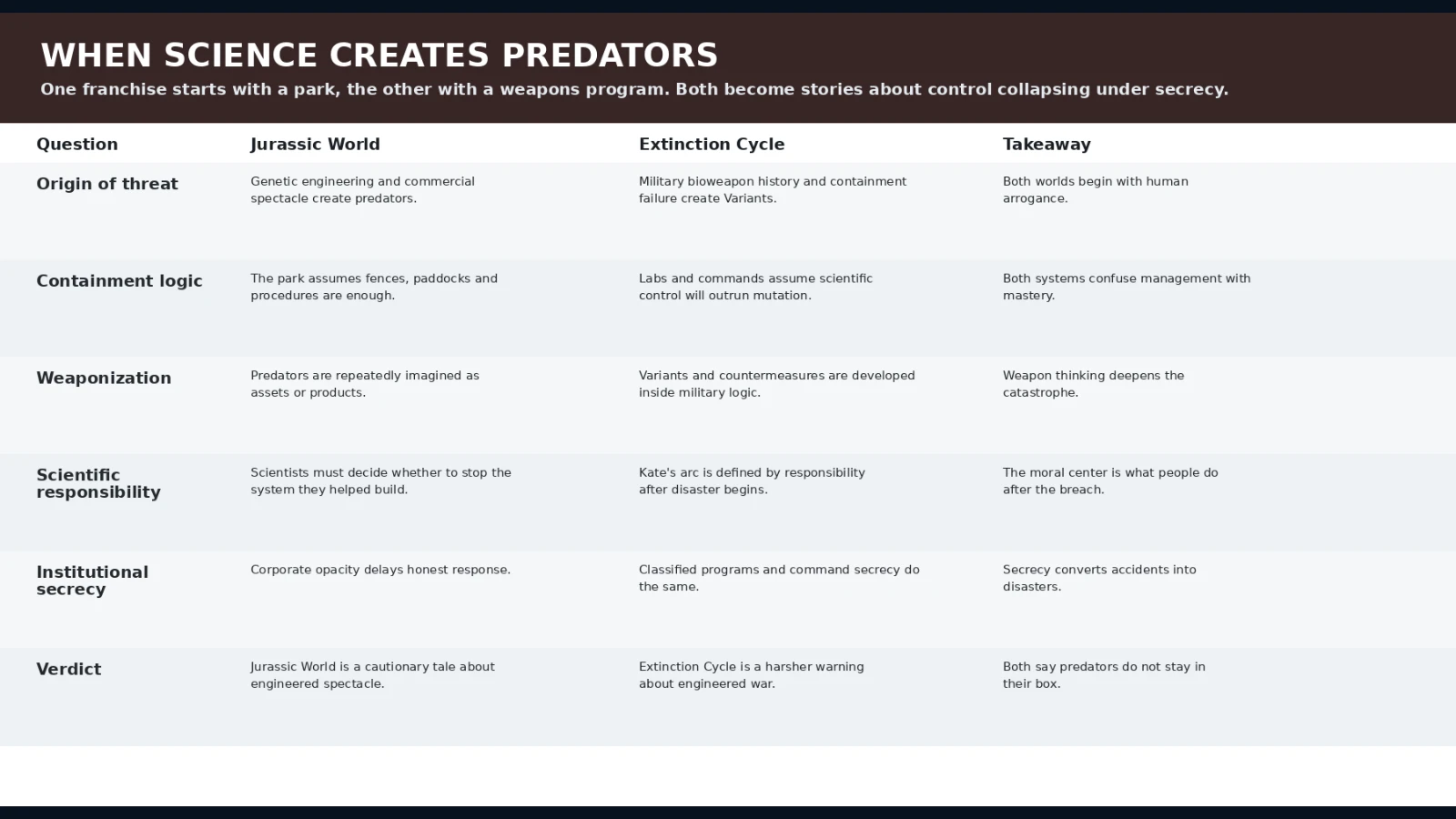
The answer in both worlds is "both," but the balance is different.
Jurassic World
Institutions deserve enormous blame because they create the incentives. Scientists still have moral agency, but the system's appetite for spectacle and productization is impossible to ignore.
Extinction Cycle
The institution again deserves major blame, but the story also asks individual scientists harder questions. Kate's arc matters because scientific responsibility does not disappear merely because she did not create the root program. Once she becomes central to the response, every countermeasure carries consequences. She becomes one of the clearest examples in modern apocalypse fiction of a scientist forced to live inside the consequences of her field.
This is where the two stories really connect.
The ethical question is not merely, "Should this have been done?"
It is also, "What do you owe the world after it has been done?"
After Disaster Begins: What Good Scientists Do
A comparison like this should not stop at blame.
It should also ask what good response looks like once prevention has already failed.
Admit reality quickly
The first task is epistemic honesty. Stop protecting the institution's self-image.
Shift from ownership to responsibility
The project is no longer "yours." The consequences belong to everyone now.
Serve survival, not ego
A scientist after disaster is useful only if they are willing to help operational responders, not merely protect their own intellectual legacy.
Accept that some solutions will be ugly
In both worlds, morally clean outcomes become rare once catastrophe is active.
Keep learning without repeating the original arrogance
This is the hardest part. The response still needs science, but it needs humbler science.
Kate embodies this tension better than almost anyone in the comparison.
The Role of Ordinary People
Another useful difference between the franchises is how the wider human cast interacts with the scientific failure.
In Jurassic World, ordinary people often experience disaster as visitors, workers, families or security personnel caught inside a system they did not design.
In the Extinction Cycle, ordinary people eventually have to become survivors, soldiers, settlers, politicians and outpost citizens. The scientific failure becomes everyone's long war.
That is why the Extinction Cycle can feel more politically mature. It forces the consequences of elite decisions onto a reconstructed society.
Predators and Scale
The scale of the created predator matters too.
A genetically engineered dinosaur is terrifying because it is immediate, physical and difficult to contain once free.
Variants are terrifying because the predator is also a population event. The enemy is not one escaped thing. It is a transformed mass of people plus later evolved forms.
This makes the Extinction Cycle a broader warning.
Jurassic World asks whether human beings can safely commercialize spectacular predators.
The Extinction Cycle asks whether human beings can survive when their weaponized biology stops recognizing the human species as the center of the system.
Why Both Franchises Distrust Control Language
Both stories are deeply suspicious of the phrase "we can control it."
That phrase may appear as management confidence, scientific optimism or military necessity. It always means the same thing.
It means somebody is pretending uncertainty is smaller than it is.
That pretense takes different forms:
- "the enclosure is sufficient"
- "the project is contained"
- "the asset is manageable"
- "the mutation is understood"
- "the risk is acceptable"
By the time those phrases become visible, the danger is already mature.
Rebuilding After Predators
Rebuilding looks different in each world.
Jurassic World
The franchise is often more interested in immediate ethical and ecological fallout: what happens when engineered creatures are loose, politicized or commodified in a wider human world.
Extinction Cycle
The series asks the more extended question of how communities rebuild after biological war. Outposts, agriculture, local leadership and politics all become part of the answer.
This is another reason the Extinction Cycle feels like the more exhaustive social warning.
It follows the consequences further.
Which Franchise Offers the Sharper Warning to Scientists?
Both offer strong warnings, but they aim at different targets.
Jurassic World's warning
Do not confuse technical capability with moral justification. If your institution is creating predators to entertain, impress or monetize, the ethical rot has already begun.
Extinction Cycle's warning
Do not imagine that strategic urgency makes biological overreach morally cleaner. If your work enters a system built on weapon logic, you may not control how your science lives in the world.
That second warning is harsher.
It assumes the institution can be patriotic, serious and highly resourced and still be catastrophically wrong.
The Public's Role in Scientific Disaster
One reason these stories resonate beyond creature-feature thrills is that they dramatize what happens when ordinary people are asked to trust systems they did not build.
In Jurassic World, the public often enters the crisis as visitors, workers or bystanders who believed experts had contained the danger.
In the Extinction Cycle, the public becomes the terrain on which secrecy's consequences are written. Citizens do not merely lose a day at the park. They lose the world they expected to inhabit.
That difference matters because it changes the moral pressure on scientists. Once the public is living inside the damage, "technical complexity" stops sounding like an excuse and starts sounding like a privilege.
The Difference Between Cure Logic and Control Logic
Another important distinction between the franchises is what institutions believe they are trying to achieve.
In Jurassic World, the dominant language is often control: enclosure, display, handling, command, containment and asset management.
In the Extinction Cycle, the language is split between control and cure. Scientists and soldiers are trying to stop a bioweapon catastrophe while also surviving it. That creates a sharper moral tension. Some forms of intervention are acts of rescue. Others repeat the original sin of trying to master biology through force.
Kate matters so much in this context because she embodies the struggle to use science responsibly after science has already been used irresponsibly.
Why the Stories Still Feel Current
The popularity of these comparisons comes from more than nostalgia. Modern audiences recognize the institutional behaviors being critiqued:
- overconfidence
- information bottlenecks
- incentive structures that reward good news over accurate news
- the tendency to call something "contained" before the system has earned that confidence
- the hope that technical brilliance can substitute for ethical clarity
That is why both franchises travel beyond genre fandom. They are really arguments about responsibility.
Final Moral Difference
If the two stories can be reduced to one sentence each, it might look like this.
Jurassic World asks: what happens when people build predators to delight and impress the public and then discover that life refuses to stay inside a branded experience?
Extinction Cycle asks: what happens when people build or unleash biological systems in the name of power and then force scientists, soldiers and survivors to clean up a catastrophe that no one fully understood in the first place?
Those are different warnings, but together they create a broader one: any institution that treats living danger as manageable product or manageable asset is already farther down the road to disaster than it wants to admit.
Scientists as Characters of Consequence
One reason the Extinction Cycle often lands harder than more superficial outbreak stories is that its scientists remain morally central after the outbreak begins. They are not just exposition devices. They are people whose knowledge can save lives but whose field is also implicated in what went wrong. That dual role turns science into drama rather than background.
Jurassic World can produce a similar tension whenever the story stops treating scientists as color and starts treating them as decision-makers whose work changes what "nature" even means in the setting. The best readings of both franchises therefore push beyond "science gone wrong" and toward a more demanding question: how should expertise behave once it realizes it has been entangled with power?
The Institutional Echo
Disasters of this kind rarely stay in one department. They move outward. Security changes. politics change. funding priorities change. public trust changes. legal or military authority changes. The original experiment echoes far beyond its first enclosure or first lab. That is why both stories retain weight after the first breach scene. They understand that creation and containment are not isolated acts. They are system-wide moral choices.
Why Extinction Cycle Feels More Apocalyptic
At the broadest scale, Jurassic World remains a story about dangerous engineered creatures disrupting the human world.
The Extinction Cycle becomes a story about dangerous engineered biology rearranging the human world.
That distinction explains why the comparison works while still yielding a clear difference in severity.
What Scientists Owe the Public Once Control Fails
When a project has crossed into disaster, expertise changes meaning. The question is no longer who gets credit for the discovery. The question becomes who bears responsibility for translating knowledge into survival. Both franchises are compelling because they refuse to let expertise remain abstract. People suffer because knowledge was overconfident, compartmentalized or directed by the wrong incentives. That creates a public debt.
A responsible scientist in either world owes the public:
- plainspoken honesty
- refusal to protect reputation at the cost of lives
- collaboration with responders
- openness to ethical limits
- willingness to stop treating the subject as an asset once it has become a public threat
This is one reason readers respond so strongly to scientist characters who change under pressure. Redemption, where it exists, comes not from brilliance alone but from service.
Why These Stories Are Really About Governance
The laboratory and the paddock may be the visible starting points, but the larger story in both franchises is governance. Who sets the priorities? Who is allowed to know the truth? Who can say stop? Who absorbs the downside when leadership gets the risk calculation wrong?
Once the comparison is framed that way, the overlap between Jurassic World and the Extinction Cycle becomes even stronger. Both are stories about institutions that mistook technical control for moral authority.
Final Verdict
Jurassic World and the Extinction Cycle are both stories about predators humans created and then misjudged.
But they indict different forms of hubris.
Jurassic World is the warning about engineered spectacle, corporate ambition and the belief that a fenced system equals control.
The Extinction Cycle is the warning about militarized science, secrecy, bioweapon logic and the belief that strategic need excuses biological arrogance.
When disaster begins, both worlds ask the same moral question:
What do scientists owe everyone else once the thing they helped create is loose?
The best answer is honesty, humility and total commitment to survival over institutional image.
The worst answer is delay, secrecy and the hope that the old control language still means something.
So which franchise is the harsher lesson?
As a critique of profit and spectacle, Jurassic World is excellent.
As a critique of scientific responsibility under military secrecy, Extinction Cycle goes deeper and cuts harder.
Together, they form a powerful two-part warning.
Humans are very good at creating predators.
They are much less good at accepting that a created predator is no longer truly theirs.
FAQ
Are Jurassic World and Extinction Cycle really comparable?
Yes. The creatures differ, but the deeper themes of engineering, containment, secrecy and responsibility overlap strongly.
What is the main difference in origin?
Jurassic World begins with commercialized genetic wonder and later hybrid escalation. Extinction Cycle begins with military bioweapon history and viral catastrophe.
Which franchise is harsher on scientists?
Extinction Cycle is harsher because it follows scientific responsibility through a civilization-wide disaster and long-term war.
Which is harsher on institutions?
Both are severe, but they target different institutions. Jurassic World critiques corporate spectacle and product logic. Extinction Cycle critiques classified military-scientific systems.
What is the shared lesson?
Creating a dangerous predator is bad. Believing that procedures and secrecy will permanently control that predator is worse.
Does either franchise say science is the enemy?
No. Both are really warning against arrogance, compromised institutions and the misuse of science.
Editorial note
All page imagery is original and generic. It suggests containment breach, research failure and quarantine atmosphere without reproducing copyrighted characters or official franchise art.